






This isn’t a global shortage of plastic. It’s a colour problem.
When a retailer says your usual shade is out of stock, it’s often because that exact colour hasn’t been on the production schedule lately, or it didn’t make it through QC in enough volume to keep shelves full.
Colour turns one spool into a specific formula that has to be produced, scheduled, quality-checked, packaged, and shipped as its own SKU. When demand spikes (especially from multi-colour printing), the popular shades get hammered first.
This post breaks down why it happens, why filament is sold out in a few specific shades (not all of them), and how to keep your projects moving when the exact colour you want disappears.
What “filament colors out of stock” looks like in 2026
A useful way to sanity-check the trend is to look at a real snapshot. In April 2026, How-To Geek published a report on Bambu Lab’s filament availability problems noting that (at the time of writing) roughly a third of PLA Basic colours were out of stock and only 11 of 25 PLA Matte variants were available.
That’s just one brand, one moment in time. But it matches what many experienced makers have noticed across the market: it’s rarely “no filament.” It’s specific colours that vanish.
Key Takeaway: When a colour is out of stock, it’s usually a production scheduling and inventory problem, not a mystery shortage of raw PLA.
Why 3D printer filament out of stock is usually a colour problem
The short version: black, white, grey, and a handful of evergreen colours are easy to keep flowing. Everything else is friction.
Here are the factors that matter most for filament color availability.
1) Colour isn’t paint. It’s pigments and masterbatch
Most filament starts as base polymer pellets (PLA, PETG, ABS, etc.). Colour is added with pigments, which need to be dispersed evenly through the plastic so you don’t end up with streaks, specks, or inconsistent extrusion.
In plastics manufacturing, a common way to do this is with masterbatch: a concentrated mix of pigments dispersed in a compatible carrier resin. Hubron describes masterbatch as a concentrated mixture of pigments/additives in a polymer carrier resin that’s dosed into the base plastic during processing.
3devo’s explainer on how plastic pigments and masterbatch work gets into the practical reason this exists: dosing raw pigment powders accurately and mixing them consistently is hard, so masterbatch simplifies feeding and dispersion.
What that means for you: a colour isn’t just a label on a website. It’s a controlled recipe.
2) Colour changes and short runs cost time (and scrap)
Every time a manufacturer changes colour, they’re not just swapping a box. They have to flush out the previous colour to avoid contamination.
In broader plastics processing, colour changeovers can burn hours of production time, especially going from dark to light. As a concrete illustration, Asaclean shares a case study where a blown-film processor reduced a black-to-clear colour change from four hours to 30 minutes using a purge compound, cutting the estimated changeover cost significantly (case study).
Filament extrusion isn’t blown film, but the underlying reality transfers: colour changeover is downtime, and downtime is expensive. This pushes manufacturers to:
- run longer batches of the best sellers
- minimise frequent switches to niche shades
- accept that some colours will go unavailable between runs
3) SKU sprawl makes forecasting harder than it looks
One material can have dozens of colours, finishes, and packaging variants. Multiply that by multiple materials (PLA, PETG, ABS/ASA, TPU), plus spool vs refill, plus “matte/silk/translucent,” and you get a long-tail inventory problem.
No brand wants to warehouse months of slow-moving colours. But if they don’t, they’ll still sell out quickly when a shade goes viral.
4) Quality control is stricter for some colours
Some pigments are more finicky to process consistently. If a colour run doesn’t meet tolerance for diameter, consistency, or appearance, it gets reworked or scrapped.
You’ll never see the rejected spools. You’ll just see “out of stock.”
Why the colour crisis feels worse in 2026
There are two big accelerators.
Multi-colour printing increased colour-specific demand
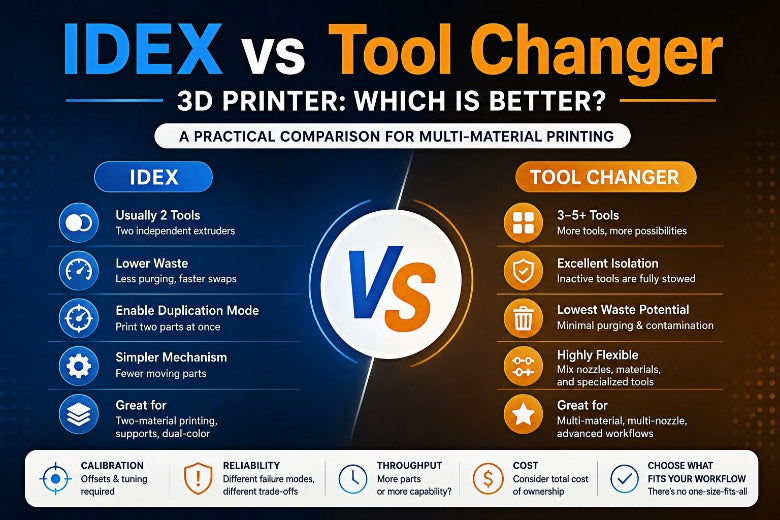
Multi-colour FDM printing is more accessible now than it was a few years ago. More people are printing colour-heavy models, and multi-colour workflows can increase how quickly you burn through certain shades.
If you want a plain-English refresher on how these systems work, SOVOL has a solid explainer on how multi-colour FDM printing works.
Makers are doing more small-batch and “repeatable aesthetic” work
Advanced hobbyists aren’t just printing one-off benchies. They’re printing matching sets: organisers, enclosures, cosplay parts, storefront products, replacement parts for past builds.
That kind of work needs colour continuity. Stock-outs hurt more when you need “the same blue as last time,” not “any blue.”
The maker playbook: how to stop stock-outs from wrecking your projects
This is the part you can control.
Step 1: Decide where colour matters, and where it doesn’t
Before you commit to a colour for a long print or a batch run, ask:
- Does this part need to match an older print?
- Will it be visible in normal lighting?
- Is the goal “exact shade” or “consistent look” (matte vs glossy, dark vs light)?
If it’s not visible, you can often standardise on a boring, always-available filament and save the special colours for surfaces that actually show.
Step 2: Build a swatch library (so you can substitute fast)
If you’re printing functional parts or small batches, a swatch library saves more time than it costs.
Simple system that works:
- Print a small standard swatch model for every new spool you buy.
- Write the brand, material, colour name, and purchase month on the back.
- Store swatches by “family” (neutral, warm, cool) rather than by brand.
Now, when your go-to colour is sold out, you can grab the closest substitute in minutes.
Pro Tip: Photograph your swatches under one consistent light (same desk lamp, same background). It makes online “close enough” choices less of a gamble.
Step 3: De-risk long projects with a “same-batch rule”
If a project needs colour continuity, don’t start it with a single spool unless you’re sure that’s enough.
A practical rule: if you’ll need more than one spool, buy them together (ideally same batch/lot when available). Even if the shade is consistent across the brand, you’re protecting yourself from the real problem here: availability gaps.
Step 4: If you buy ahead, store it like it’s going to sit for months
Stock-outs push people to buy ahead. That only helps if your backup spools still print well.
Moisture is the quiet way “backup filament” turns into a failure factory.
A good storage baseline:
- Keep open spools sealed (bag or box) with desiccant.
- Track when a spool was opened.
- If prints start showing bubbles, stringing, or rough surfaces, dry the filament before blaming your profile.
SOVOL has several practical guides that are worth linking here:
- Prevent moisture bubbles in 3D printing — filament storage tips
- 5 proven methods to dry wet filament
- Filament storage tips to prevent stringing and jams
Step 5: Plan a “finish strategy” for sold-out colours
If the exact colour matters and you can’t get it, you’ve got three realistic options:
- Change the visible finish: move to a different colour family but keep the same sheen (matte to matte).
- Reframe the design: add a second colour intentionally (contrast panels, labels, accents) so it looks deliberate.
- Post-process for consistency: paint, dye, wrap, or coat. It’s extra work, but it decouples your project from a fragile supply chain.
UK note: why ordering “just one more spool” can take longer than you expect
UK availability can look fine until you’re trying to match a specific shade from a specific brand. Then you hit shipping and import friction.
One practical rule to remember: GOV.UK notes that for goods worth more than £135, you may need to pay VAT (and possibly duty, depending on goods) to the delivery company before delivery (tax and duty on goods sent from abroad). That doesn’t mean “don’t buy from abroad.” It means: don’t assume a last-minute order will arrive in two days with no extra steps.
Key takeaways
- Popular filament colours go out of stock because colour adds manufacturing and inventory friction.
- Pigments and masterbatch have to be processed consistently; you can’t restock a specific shade instantly.
- Changeovers and short runs cost real production time, so brands prioritise high-volume colours.
- Multi-colour printing and small-batch maker work make the problem feel worse in 2026.
- Your best defence is a swatch library, a same-batch rule for long projects, and proper storage for buy-ahead spools.
If you want, I can turn the “maker playbook” section into a one-page printable checklist for your workshop wall.