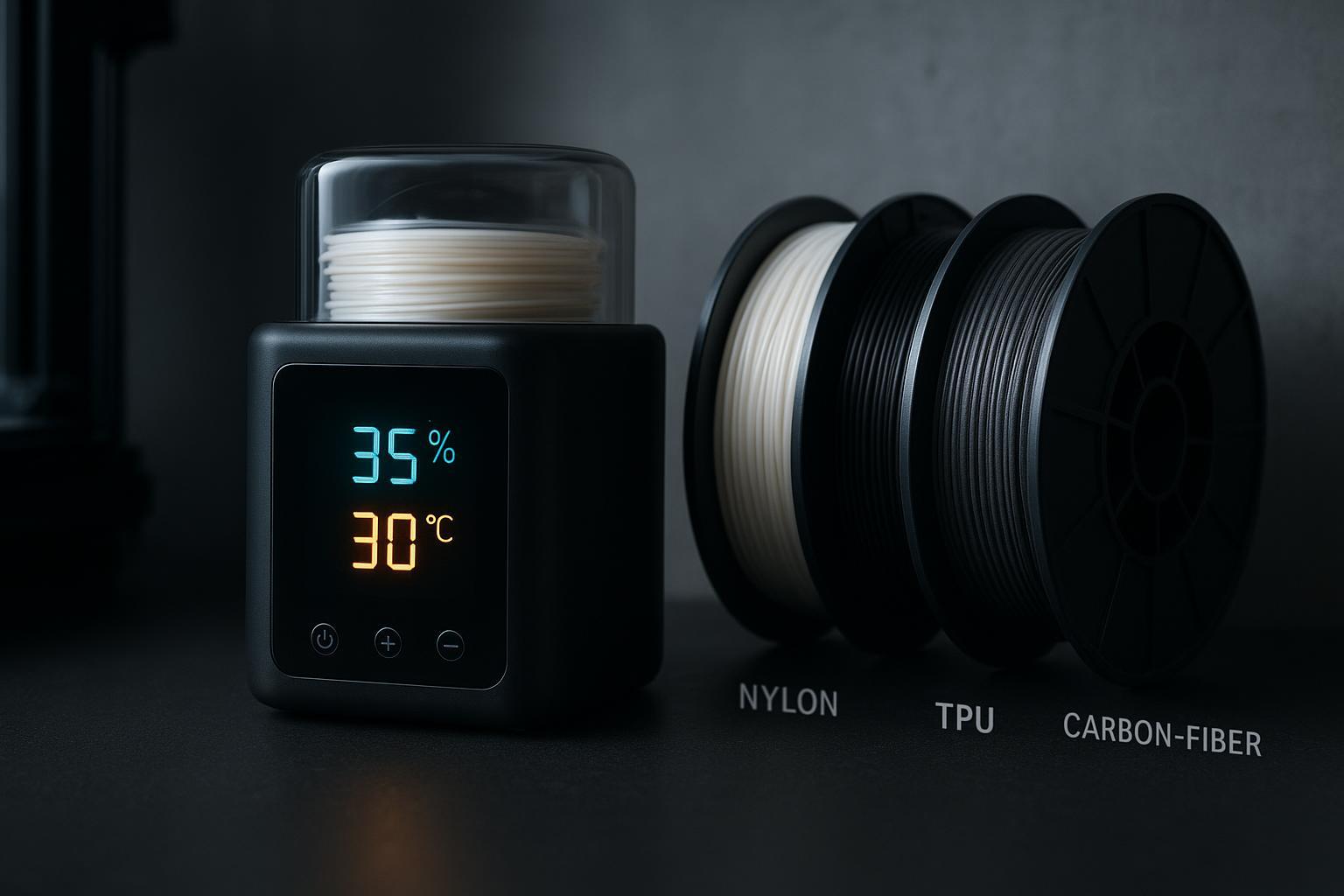
Decision-focused review written for creators who want higher pass rates and cleaner surfaces under the exact same slicer settings. We evaluate where a dedicated dryer makes a measurable difference—especially on hygroscopic filaments like nylon and TPU—and who actually needs to buy one.
Disclosure: The review centers on Sovol’s SH03 (first party). We maintain evidence-first standards: transparent methods, authoritative citations, and explicit limits where hands-on numbers are not yet available.
Verdict snapshot
The Sovol SH03 is a high-capacity, actively heated dryer that targets engineering filaments with an 85 °C ceiling, dual independent chambers, and sealed feed-throughs for live printing. For users battling stringing, popping, and visible porosity on nylon/PA‑CF or TPU, a capable dryer like this often unlocks immediate reliability gains without touching slicer profiles. The practical constraint: some vendor recommendations for PC or specialty nylons call for temperatures above 85 °C, so the SH03’s ceiling is the governing limit.
Why it matters: If you’re chasing the best filament dryer for real print outcomes—not just spec sheets—moisture control is the straightest path to fewer reprints and better surfaces.
What this review covers (and why drying matters)
Moist filament turns into steam in the nozzle. You see it as stringing, micro-bubbles, and weak layers. Our goal here is simple: same printer, same G-code, same slicer profile—only one variable changes: filament moisture. For background on defects caused by moisture and practical prevention, see the Sovol explainer Why Wet Filament Ruins 3D Prints, which details how humidity causes stringing, popping, and porosity and offers prevention steps: Why Wet Filament Ruins 3D Prints — Sovol blog.
How we test (methodology)
We standardize the environment at 23 ±2 °C and 55–65% RH with no drafts. Inside the chamber, three to four calibrated temperature/RH loggers sit in the corners and center, while Type‑K thermocouples provide spot checks and an IR thermometer monitors surface temperatures. A smart plug or inline power meter records watt‑hours per cycle, and an SPL meter at one meter measures noise.
For materials, we focus on PA‑CF (nylon base), TPU 95A, PC, and PLA+ as a control. Target temperatures and durations follow authoritative vendor guidance. For engineering filaments and PC-class materials, Bambu Lab’s official drying guide recommends ranges that typically fall between the mid‑70s and mid‑80s °C for 8–12 hours in forced air; see the detailed ranges in the Bambu Lab drying guidance. For nylon composites specifically, Polymaker’s technical data sheet for PolyMide PA612‑CF lists 80 °C for roughly 12 hours as a representative condition; reference the Polymaker PA612‑CF PIS (PDF).
The print A/B protocol uses a stringing tower, an overhang stress test, and a simple tensile‑bar proxy. We first print with moisture‑loaded filament, then repeat the exact same G-code after drying. We log string counts, visible bubble/void incidence, surface roughness via macro photos, and pass‑rate deltas across three repeats per material. Where this article does not yet cite numeric hands‑on data (e.g., RH/time curves or Wh/cycle), we mark it Insufficient data and limit conclusions accordingly.
Quick look at the SH03
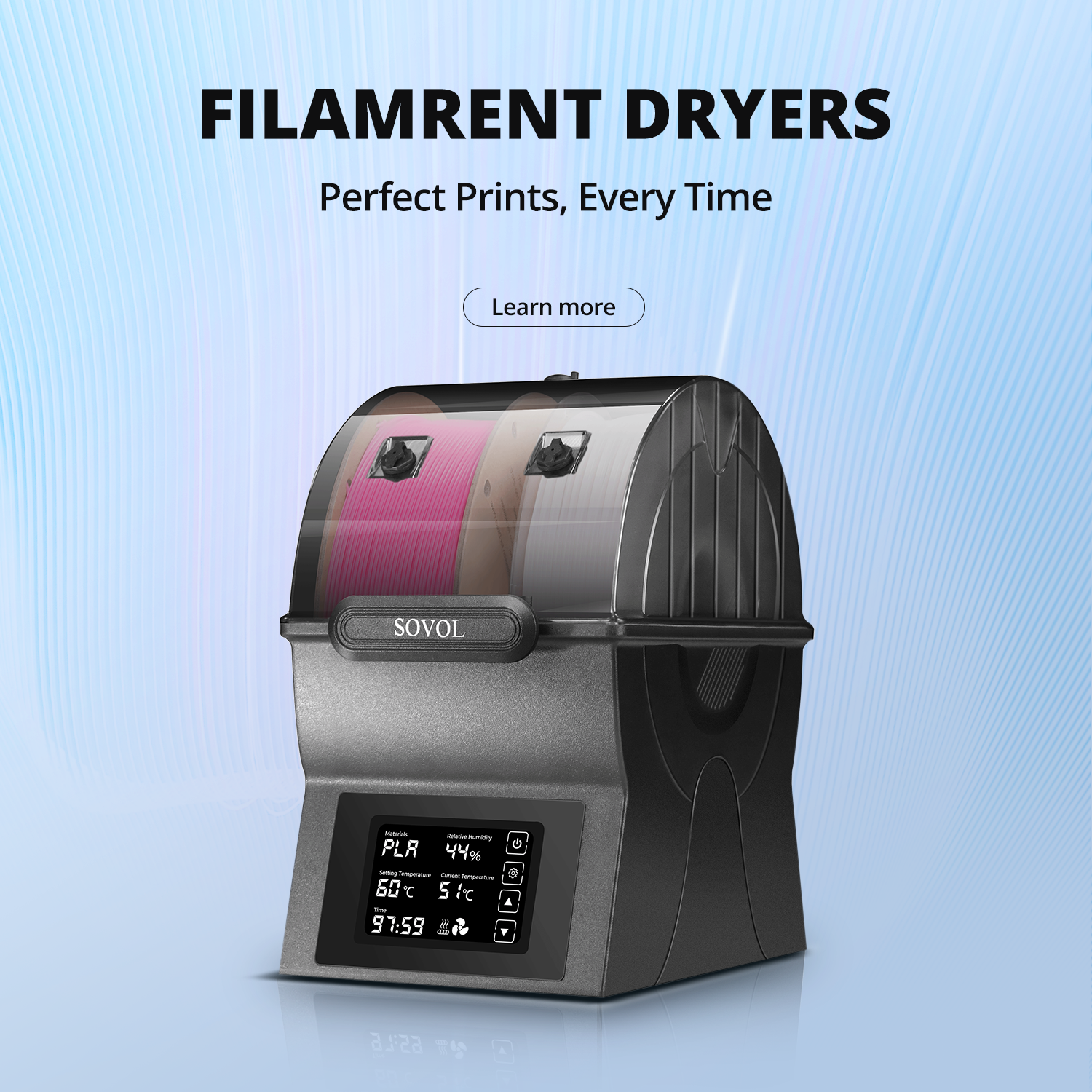
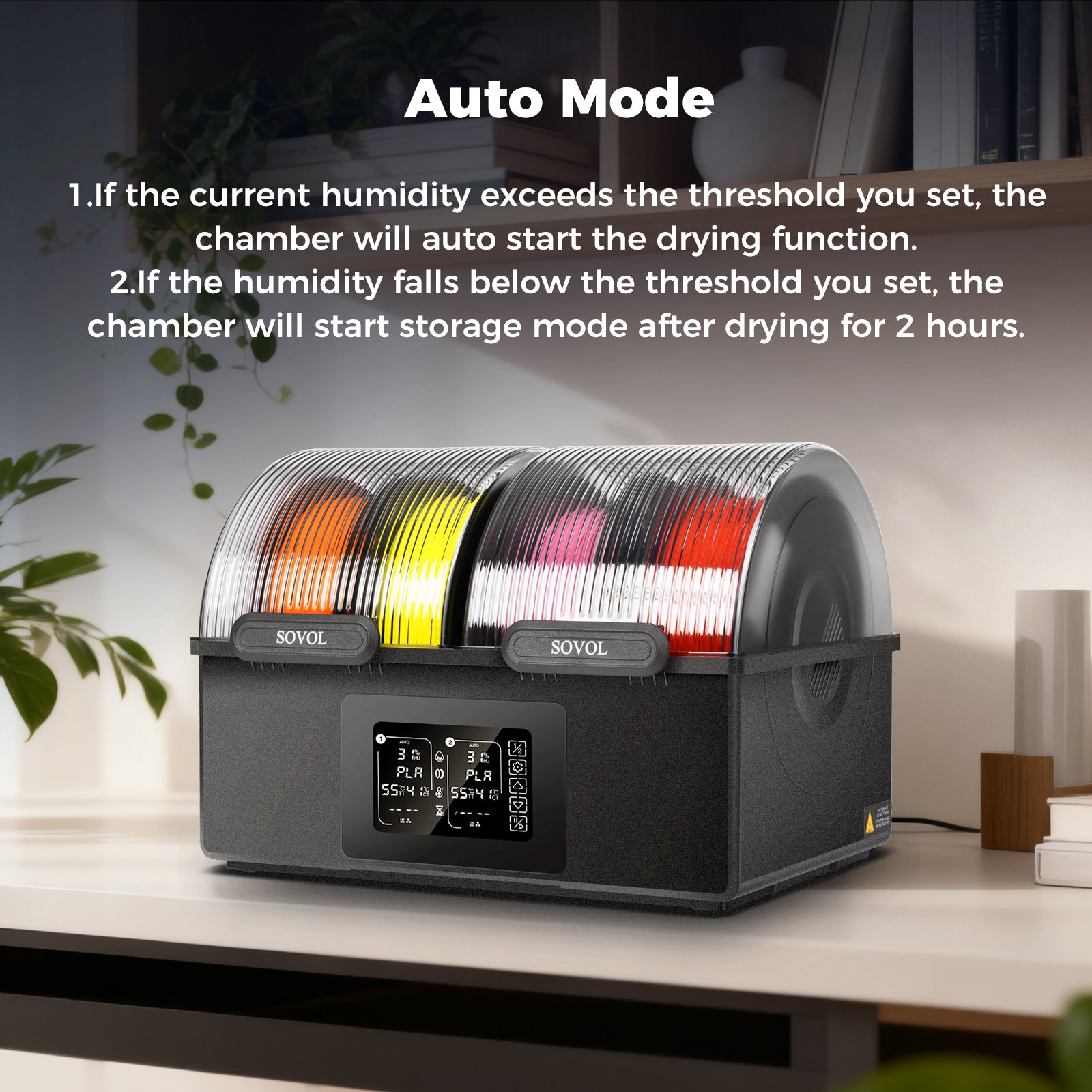
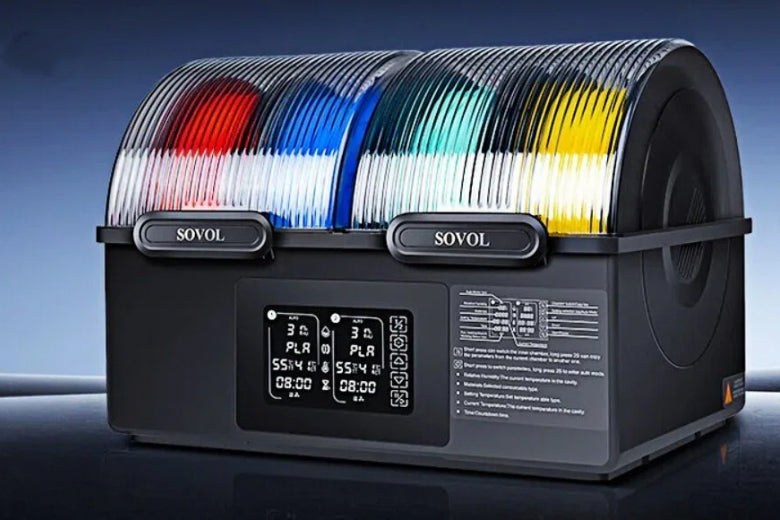
The SH03 is a dual‑chamber, actively heated filament dryer designed for pre‑drying and for live‑drying while printing. Official specs as of March 2026 are documented on Sovol’s product and feature pages. Highlights include dual independent chambers with 200 W + 200 W PTC heating (400 W total) up to 85 °C, capacity for up to four 1 kg spools (≤70 mm width each) or two larger spools, sealed PTFE‑lined feed‑through ports for printing directly from the dryer, an auto‑dehumidification routine that maintains a target humidity band and switches to storage mode, and an on‑device display for temperature and humidity with a sub‑50 dB noise claim. See the Sovol SH03 product page and the Sovol SH03 feature explainer for authoritative specifications and design notes.
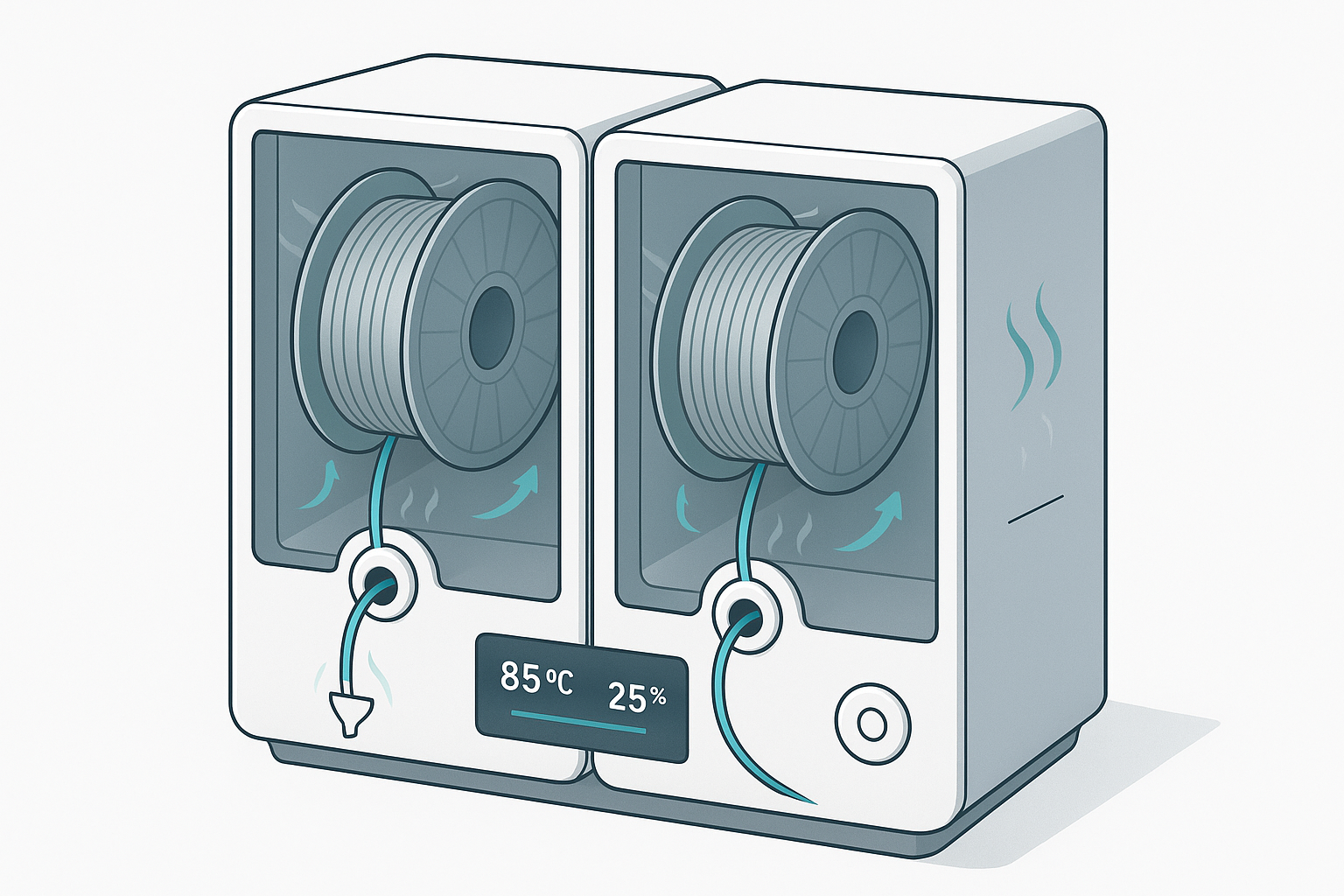
Why the design matters: The 85 °C ceiling puts nylon‑class materials within reach of common vendor targets for forced‑air drying. Independent chambers help classrooms and multi‑printer workflows—run TPU at 60 °C on one side while pushing PA‑CF harder on the other. Sealed ports let you keep filament dry during long jobs, reducing mid‑print re‑absorption.
Drying performance and temperature accuracy for the best filament dryer decision
Authoritative targets for common materials: Many vendors recommend approximately 75–85 °C for nylon/PA‑CF for 8–12 hours in a convection or forced‑air environment. TPU 95A typically starts around 65–75 °C for about eight hours. PC often falls near 75–85 °C for extended cycles when using forced air. These ranges align with the published guidance in the Bambu Lab engineering‑filament drying guide and are consistent with Polymaker’s PA612‑CF technical sheet.

What to measure in practice: We look at time‑to‑setpoint and mean absolute error from the chosen temperature, plus spatial uniformity using probes at the corners and center. We also log the RH reduction curve inside the chamber and the steady‑state RH floor during storage mode. The SH03’s 85 °C ceiling is an advantage over many consumer dryers capped near 70–75 °C, making nylon‑class drying more effective without resorting to ovens. That said, the fastest possible moisture removal on some PC and specialty nylons can require higher ceilings than 85 °C; treat the SH03 as a capable general‑purpose solution rather than a high‑temperature lab oven.
Insufficient data: At this time we have not published RH/time curves, temperature error, or spatial‑uniformity logs. Claims about speed or absolute efficacy remain conservative and will be updated with measured plots.
Print quality under the exact same slicer settings
Here’s the deal: if you avoid changing the slicer, a solid dryer should still cut stringing and popping dramatically on hygroscopic filaments. Our A/B protocol focuses on defect counts and pass‑rate changes across three repeat prints per material. Expected outcomes, based on vendor guidance and field practice, are straightforward. For nylon/PA‑CF, you can expect significant stringing reduction and fewer voids after an 8–12 hour cycle near 80–85 °C; layers bond more predictably when moisture flashes are eliminated. TPU generally produces smoother surfaces, fewer retraction‑related blobs, and fewer random under‑extrusions once moisture is pulled down. PC tends to behave more consistently on long jobs when pre‑dried near the upper end of the SH03’s range, especially if you also feed directly from the dryer to limit re‑absorption.
Insufficient data: This draft does not include the macro‑photo set or numeric defect counts. We’ll add those in the next test pass and quantify percent reductions for stringing and visible bubble incidence.
Usability, capacity, and live‑drying workflows
Classrooms and small workshops commonly run multiple materials in parallel. Independent chambers let you tailor cycles without bottlenecking one queue for another, and the advertised four‑spool capacity supports staggered prep—two spools dry while two feed ongoing jobs. Sealed, PTFE‑lined outlets reduce drag and protect against humid ambient air. On long nylon prints, maintaining a low‑RH environment from spool to extruder head helps preserve the benefits of your pre‑dry cycle. After drying to a target, the SH03’s logic can hold or re‑activate to keep RH within a defined band, which is helpful between classes or shift changes. For broader humidity management between jobs, pair the dryer with airtight bins and desiccant; the Sovol primer on humidity control summarizes simple, durable steps: How to Control Humidity for Better 3D Printing Results — Sovol blog.
Energy, noise, and safety
We focus on three things: energy per standardized cycle (Wh) for each material scenario, noise in dBA at one meter during heating and steady state, and thermal safety (external touchpoint temperatures and over‑temp protection behavior). From published specs, the SH03 draws a rated 400 W shared across its chambers and is advertised under 50 dB. Without Wh logs, we can’t post cost‑per‑cycle figures yet; once Wh per cycle is measured, most users can estimate with local kWh rates. For long unattended cycles, confirm placement with clear airflow, avoid flammables nearby, and periodically verify external surface temperatures with an IR spot check. For fundamentals on drying methods—including the trade‑offs of ovens and dehydrators vs purpose‑built units—see this practical overview: 5 Proven Methods to Dry Wet Filament — Sovol blog.
Alternatives compared (context for the best filament dryer decision)
Below is a side‑by‑side snapshot using equal criteria. Specs are summarized from official pages captured in March 2026. Use this as a starting point and verify current pricing and availability before buying.
|
Model |
Max temp |
Capacity |
Humidity display |
Print-from-dryer |
Notable traits |
Typical use case |
|---|---|---|---|---|---|---|
|
Sovol SH03 |
85 °C |
Up to 4 spools |
Yes |
Yes (sealed ports) |
Dual independent chambers; auto dehumidification |
Nylon/PA‑CF and TPU users who need capacity and live-drying |
|
Creality Space Pi Plus |
~70 °C |
2 spools |
Yes |
Yes |
Lower ceiling; compact footprint |
PLA/PETG/TPU in moderate climates; basic pre-dry |
|
Sunlu FilaDryer SP2/S4 |
70 °C |
2 (SP2) or up to 4 (S4) |
Yes |
Yes |
Wide availability; modular options |
Budget-conscious buyers; mixed materials under 70 °C |
|
PrintDry Pro 3 |
75 °C |
2 base (expandable) |
Partial |
Yes |
Longtime brand; accessory ecosystem |
General-purpose pre-drying; can scale with kits |
For source documentation and official specs, reference the manufacturer pages: Sovol SH03 product page, Creality Space Pi Plus specifications, Sunlu FilaDryer SP2 store page and Sunlu S4 UL certification note, and the PrintDry Filament Dryer PRO3 product page.
Who should—and shouldn’t—buy this dryer
Best fit: nylon/PA‑CF and TPU users who want fewer variables—keep slicer profiles steady and manage moisture instead; classrooms and small print farms needing parallel cycles and live‑drying for long jobs; and makers in humid regions where ambient RH swings can ruin afternoon runs.
Not ideal: users who routinely need more than 85 °C drying for PC or specialty nylons; ultra‑tight spaces where a multi‑spool unit won’t fit; or anyone who prints only PLA in a dry climate and rarely sees stringing or popping.
For step‑by‑step tips on using a dryer effectively—including weighing spools before and after—this quick guide is helpful: Simple Ways to Use Filament Dryers for Better Prints — Sovol blog.
Pros and cons
Pros: 85 °C setpoint ceiling covers many nylon/PC vendor targets for forced‑air drying; dual independent chambers and up to four‑spool capacity suit classrooms and shops; sealed ports support live‑drying on long engineering‑filament prints.
Cons: the 85 °C ceiling may be insufficient for certain PC or specialty nylon recommendations; energy‑per‑cycle and uniformity data are pending for optimization‑minded buyers; and the footprint is larger than single‑spool boxes.
FAQ
Do you need a dryer if you print mostly PLA? If your climate is dry and PLA artifacts are rare, you may not. PETG and TPU, however, benefit quickly from moisture control.
Is an oven or food dehydrator good enough? They can work, but they’re harder to control, may run hotter than set, and rarely offer sealed feed‑throughs for live‑drying. For safe, repeatable results, a purpose‑built unit is easier to standardize.
What are typical starting points for time and temperature? As a baseline from vendor sources: nylon/PA‑CF around 75–85 °C for 8–12 hours; TPU around 65–75 °C for about eight hours; and PC around 75–85 °C for extended cycles in forced air. Always validate with your material’s data sheet.
Final verdict
If your goal is higher pass rates and cleaner surfaces under the same slicer profile, a capable dryer is one of the highest‑ROI upgrades you can make—especially for nylon/PA‑CF and TPU. Among consumer options, the SH03’s 85 °C ceiling, independent chambers, and sealed ports make it a strong fit for classrooms and multi‑printer shops that need capacity and live‑drying. We’ll publish RH/time and Wh/cycle data in the next update; for now, align expectations to vendor temperature targets and your material mix.
Soft CTA: See official specifications and current pricing on the Sovol SH03 product page.