


But for hobbyists, “profitability” usually isn’t about selling prints. It’s about whether recycled filament lowers your cost per successful print—without quietly increasing the stuff that makes printing expensive: failed parts, nozzle clogs, extra tuning time, and spools you stop trusting.
This guide breaks down what really drives recycled filament profitability today, in the UK, and how to think about buying recycled filament vs recycling your own.
Key Takeaways
- Recycled filament is only “cheaper” if it doesn’t raise your failure rate or tuning time.
- The biggest hidden costs are usually moisture, contamination, and inconsistent extrusion (not the sticker price).
- Buying recycled filament can be a low-effort win if the supplier controls consistency and you match the filament to the right jobs.
- DIY recycling/extrusion can work, but your “cost” becomes process control: sorting, drying, filtering, diameter control, and troubleshooting.
Recycled filament profitability: the definition that matters for hobbyists
Let’s make this concrete.
For an advanced FDM hobbyist, recycled filament is “profitable” when it reduces your total cost for a finished part—including the parts you don’t get because they failed mid-print.
That total cost usually includes:
- Material cost (what you paid per kg, plus shipping, plus waste)
- Time cost (extra tuning, retries, cleaning clogs)
- Failure cost (lost hours, lost electricity, trashed supports, trashed parts)
- Risk cost (you avoid printing important parts because you don’t trust the spool)
That’s why recycled filament can be “cheap” on paper and still feel expensive in practice.
The 6 cost drivers that decide recycled filament profitability in 2026
1) Consistency (same spool, same results)
Recycled filament tends to come from a less uniform feedstock than virgin resin. In plain terms: more variability can sneak in, and variability is what creates “mystery failures.”
A broad, research-backed overview of waste plastics becoming filament notes that extrusion conditions (shear stress, temperature, oxygen exposure) can degrade polymers, and repeated processing can shift mechanical properties and print behaviour over time (see a 2020 review on turning waste plastics into 3D printing filament).
What consistency problems look like on your bench:
- one roll prints clean, the next one strings at the same settings
- extrusion feels fine… until it doesn’t (random under-extrusion or rough surfaces)
- the same model needs re-tuning between colours/batches
Profitability impact: you lose the savings the moment you burn a weekend chasing settings.
2) Moisture (the silent budget-killer)
If recycled filament arrives with extra moisture—or if it picks up moisture during storage—you’re not just getting “uglier prints.” You’re buying failure risk.
Moisture can show up as:
- stringing that doesn’t go away with retraction tuning
- little bubbles/pits on surfaces
- clogs or inconsistent extrusion
Moisture control is one of the easiest ways to protect your “cost per successful print.” Practical steps like sealed storage, desiccant, and drying reduce stringing and jams, as outlined in SOVOL’s filament storage tips for preventing stringing and jams.
Pro Tip: If you want recycled filament to behave like “normal filament,” treat drying as part of the workflow, not a rescue move after things go wrong.
3) Contamination (tiny stuff that causes big pain)
Contamination is the classic recycled-material trap.
It can mean:
- mixed polymers (PLA blended with a little PETG = unpredictable melting)
- dust, grit, label residue
- small metal particles from grinding/shredding equipment
In a real recycling experiment, CNC Kitchen highlights how foreign material can show up in recycled filament and how sorting, cleaning, and filtration decisions affect outcomes (see CNC Kitchen’s experiment recycling old prints into new filament (2021)).
Profitability impact: contamination turns into clogs, wasted nozzles, and prints you can’t trust.
4) Diameter and extrusion stability (your printer can’t compensate forever)
Even great printers have limits.
If filament diameter swings or extrusion behaviour changes mid-spool, you’ll often see:
- uneven walls
- weak layers
- random under-extrusion
- surface texture changes that look like “mystery settings”
That same CNC Kitchen experiment discusses diameter control as a real-world challenge when extruding filament from recycled parts, even with feedback systems.
Profitability impact: your best slicer profiles don’t survive inconsistent feed.
5) “Tuning tax” (how much extra work the spool demands)
You can tolerate a lot if the spool is cheap—until you realize the spool is charging you in hours.
The tuning tax includes:
- extra calibration prints
- extra flow/temp tweaking
- extra maintenance (nozzle swaps, cold pulls)
- extra drying cycles
If your aim is saving money, be honest: your time is part of the equation.
6) Use-case fit (where recycled filament is a great idea)
A recycled spool doesn’t need to be “perfect” to be valuable. It needs to be used where its failure modes don’t hurt you.
Recycled filament is often a good fit for:
- prototypes and fit checks
- non-cosmetic functional parts
- jigs, brackets, organisers
- prints where slight surface variation isn’t a deal-breaker
- recycled PLA filament spools you’re willing to “qualify” first (print a small test part before committing to a long job)
A practical industry guide notes that recycled filament performance depends heavily on recycling quality, and issues like impurities, inconsistent melt flow, and moisture can drive print problems (see Sinterit’s guide to recycled FDM filament and common quality pitfalls).
Profitability impact: using the right material on the right job is the cheapest “upgrade” you can do.
Buying recycled filament: what to check before you commit
If you want the “easy mode,” buying recycled filament is it—if you treat it like a controlled input, not a random bargain.
Here’s what to check.
A quick checklist for recycled filament (before it ruins a weekend)
- Source clarity: does the brand explain what the recycled content is (post-industrial vs post-consumer) and how it’s controlled?
- Batch consistency: do they mention batch testing, diameter control, or QC?
- Intended use: do they position it for prototyping/education/functional parts, or claim it’s for everything?
- Storage expectations: do they recommend drying or sealed storage?
- Your own plan: will you reserve it for low-risk prints first?
⚠️ Warning: If the seller’s only promise is “eco-friendly and cheap,” assume you’ll pay the difference in tuning time.
DIY filament recycling/extrusion: when it makes sense (and when it doesn’t)
DIY recycling sounds simple: shred → melt → extrude → print.
In reality, DIY “profitability” depends on whether you enjoy process control. You’re building a mini materials pipeline.
DIY makes sense when…
- you generate a lot of single-material waste (e.g., PLA-only prototypes)
- you have space and patience for drying, sorting, and cleaning
- you’re okay using the output for lower-risk prints
- you want the project for learning reasons (and savings are a bonus)
DIY usually doesn’t make sense when…
- your waste stream is mixed (PLA + PETG + TPU + filled filaments)
- you need reliable functional parts without extra validation
- you print infrequently (the overhead is constant, the output isn’t)
The DIY “gotchas” that hit profitability first
Based on practical recycling workflows and experiments:
- Sorting is not optional. Mixing polymers is how you get unpredictable melting and weak parts.
- Drying is not optional. You can’t “tune out” wet plastic.
- Filtering matters. Tiny debris becomes nozzle pain.
- Diameter control is hard. Even if you can extrude, producing consistent filament is a different challenge.
- Heat history matters. Keeping polymer molten too long can degrade it, reducing performance (the 2020 review above explains how processing conditions can degrade polymers).
If you still want to try it, start with a simple rule: recycle for learning first, savings second.
A quick decision table: buy recycled vs DIY vs stick with virgin
Use this as a practical “what should I do next?” filter.
|
Your situation |
Buy recycled filament |
DIY recycle/extrude |
Stick with virgin |
|---|---|---|---|
|
You want lower material cost with minimal hassle |
✅ Best fit |
❌ Usually too much overhead |
⚪️ Fine, but you may miss savings |
|
You hate failed prints more than you love bargains |
⚪️ Only with a trusted supplier + drying |
❌ High risk |
✅ Best fit |
|
You print lots of prototypes and cosmetic perfection isn’t critical |
✅ Strong fit |
⚪️ Possible |
⚪️ Possible |
|
You enjoy building machines/processes |
⚪️ Fine |
✅ Strong fit |
⚪️ Fine |
|
Your scrap is mixed materials / unknown sources |
❌ Risky |
❌ Very risky |
✅ Best fit |
Next steps (keep it simple)
- Pick a “low-risk” print category for your first recycled spool (prototypes, organisers, brackets).
- Make drying and storage part of the workflow—not a last resort. If you need a baseline, start with SOVOL’s filament storage tips.
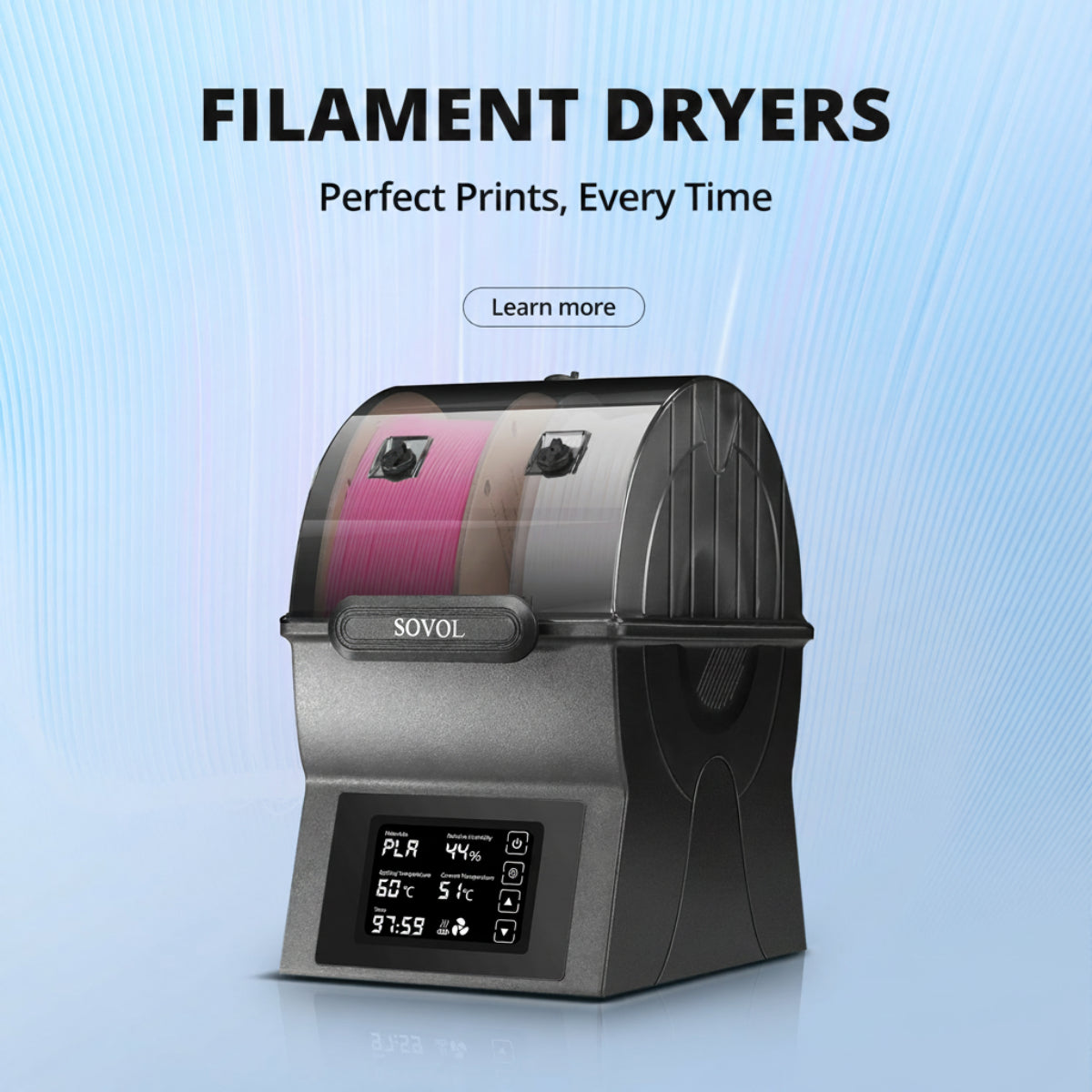
- If humidity is part of your reality, consider a dedicated dryer box so recycled spools don’t become “mystery spools.” For example, SOVOL’s SH01 filament dryer is one simple option.
If you want, I can also turn this into a one-page printable checklist you can keep next to your printer (no ROI math, just decision clarity).