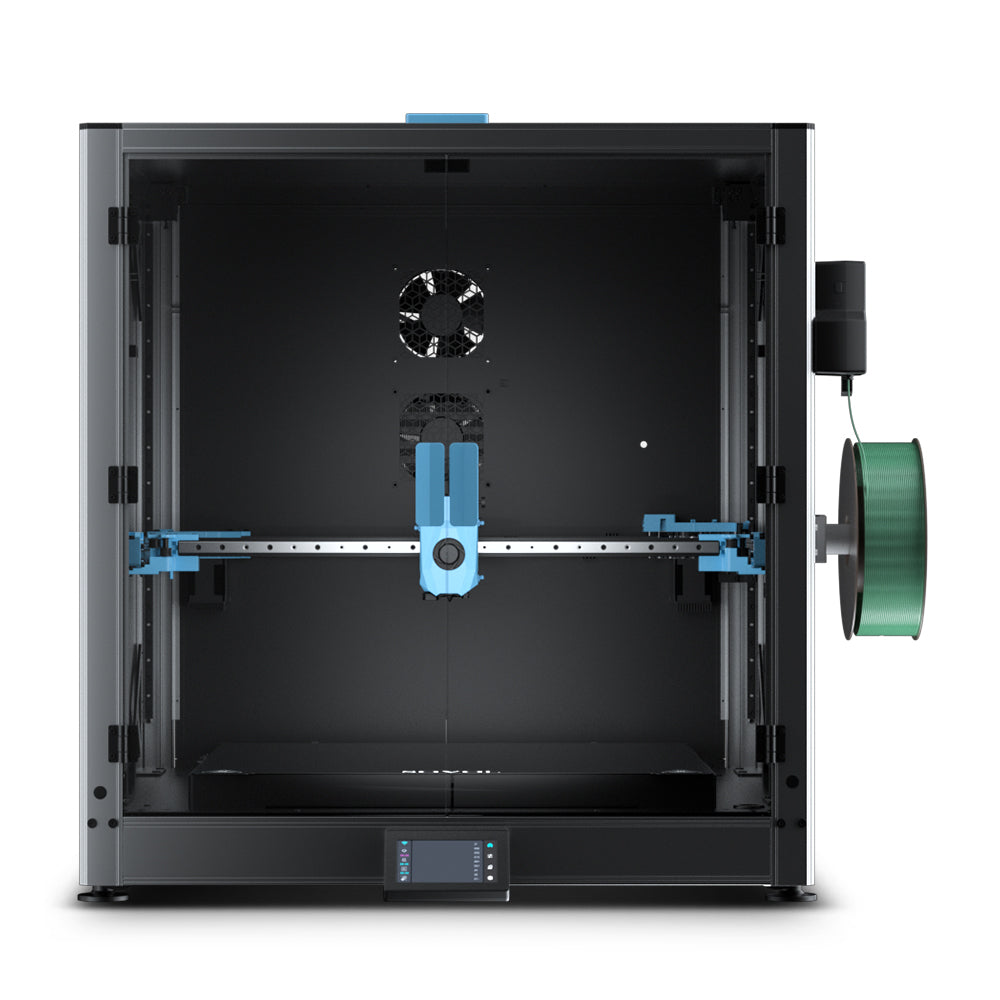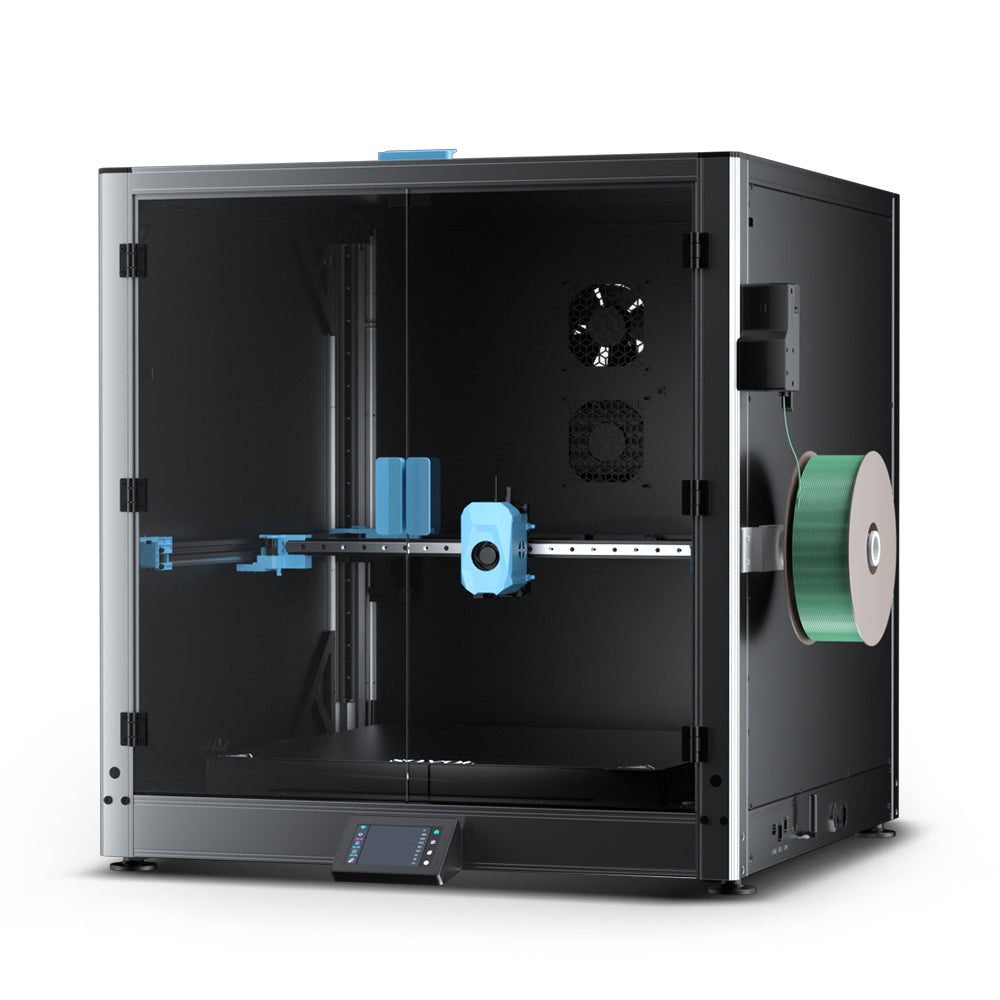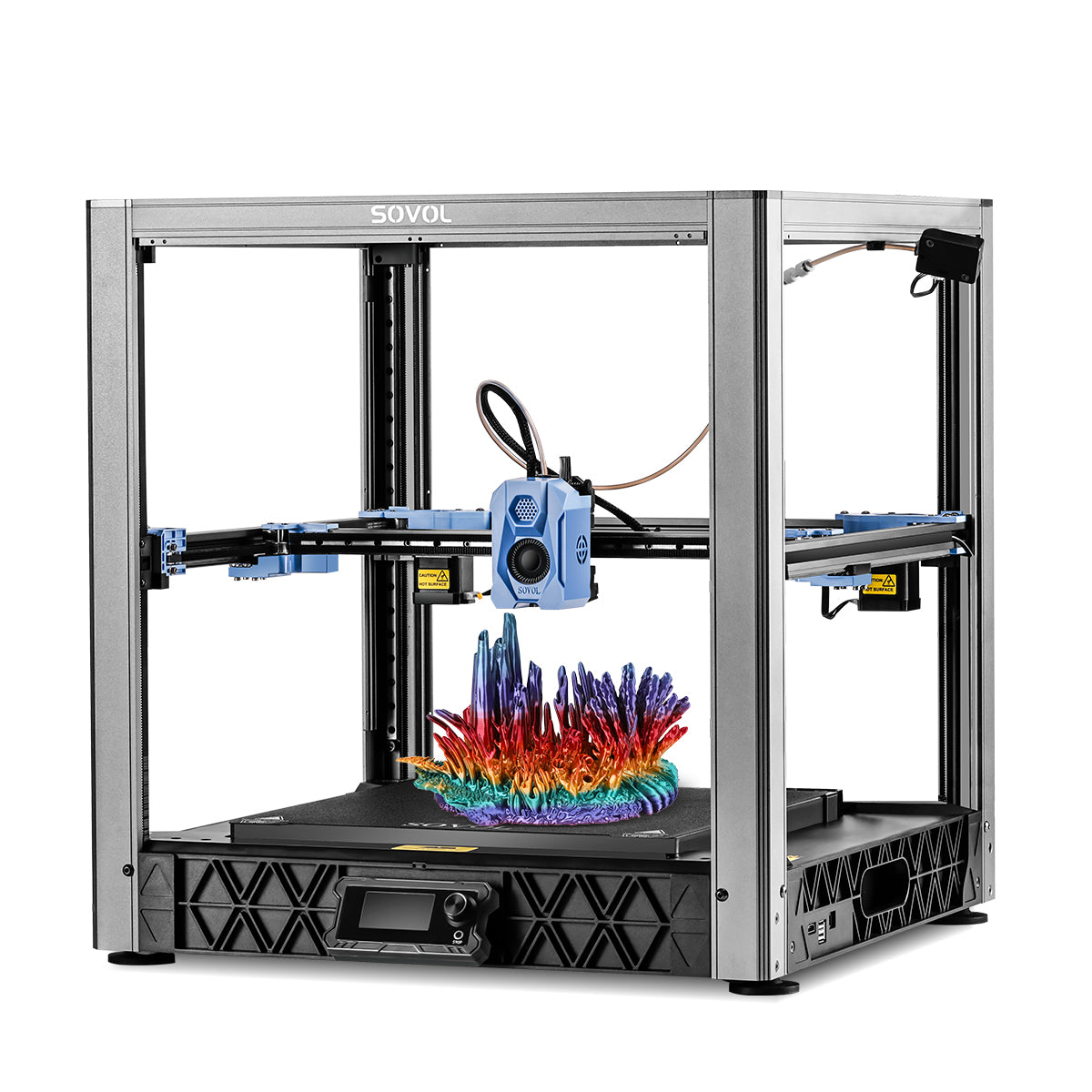
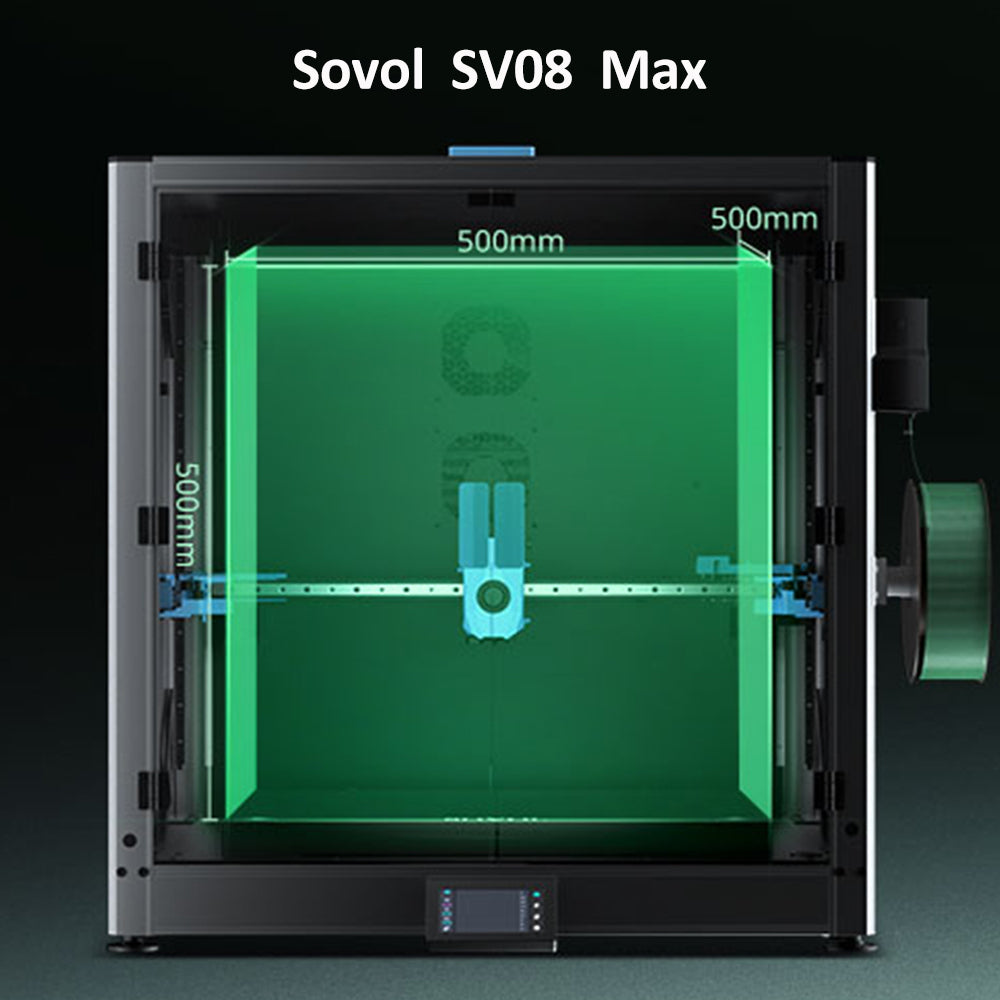
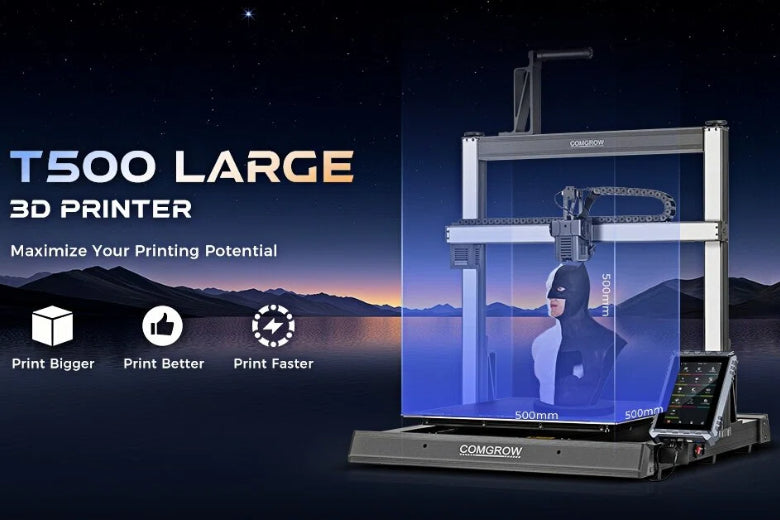
- A 500×500×500mm build volume delivers 125 liters of printable space—roughly 8 times the capacity of standard 250mm desktop 3D printers.
- Massive capacity allows makers and engineers to accommodate many large cosplay props, functional jigs, and batch layouts in a single print when the model dimensions, orientation, supports, and material behavior allow it.
- The Comgrow T500 combines a 0.5-meter cube build envelope with full XYZ linear rails, native Klipper firmware, a 300°C all-metal hotend, and 49-point auto bed leveling.
- Buyers should plan for a substantial workbench footprint, proper frame stability, and open-frame material selection (PLA, PETG, TPU, and carbon-fiber blends).
Why Build Volume Matters in 3D Printing

Standard consumer FDM 3D printers usually feature build envelopes around 220×220×250mm or 300×300×300mm. While these dimensions work well for small brackets and desk accessories, they quickly create bottlenecks when working on larger physical projects.
When a model exceeds standard build dimensions, makers must slice the file into multiple sub-components, print each piece sequentially, and then manually align, glue, fill, and sand the seams. Multi-part assemblies add seams, alignment work, and post-processing, while a single-piece print can reduce these challenges. Final strength still depends on layer orientation, material, and part design.
Expanding the printable build envelope changes this workflow entirely. By printing single-piece large components, creators save substantial labor and maintain continuous extruded structures directly off the build plate.
What Does a 500×500×500mm Build Volume Mean?

A 500×500×500mm build volume provides a nominal 125-liter printable space. A standard 250×250×250mm build volume yields roughly 15.6 liters of volumetric space. Increasing each axis to 500mm expands printable volume to 125,000 cubic centimeters (125 liters)—an eightfold increase in total print capacity.
Standard Desktop Printer (250 × 250 × 250 mm) = ~15.6 Liters
Large-Format Printer (500 × 500 × 500 mm) = 125.0 Liters (8x Volume Increase)
In practical terms, a 0.5-meter print bed provides expanded layout space. The theoretical diagonal across a 500×500mm bed is about 707mm, although the usable diagonal depends on edge clearance, model geometry, and the slicer. Objects that previously required multiple separate print cycles can often be printed in a single job.
Comgrow T500 AU Warehouse Clearance
At the time of writing, the Comgrow T500 is available from the Australian warehouse for US$499 while stock lasts.
What Can You Print with the Comgrow T500?
A large-volume machine like the Comgrow T500 large-format 3D printer opens up distinct practical applications across hobbyist, industrial, and commercial workflows.
Large Cosplay Props and Helmets
Cosplay creators regularly print full-head helmets, chest armor, and prop weapons. On conventional printers, an adult wearable helmet often needs to be sliced into smaller sections and glued together.
With a 500mm vertical and horizontal reach, many adult-sized helmets and large props can be printed in one piece, depending on their specific dimensions and orientation. This eliminates weak glue lines, simplifies fitting, and reduces surface prep time before painting.
Engineering Prototypes and Functional Parts
Engineers and product designers often require full-scale functional prototypes to verify form, fit, and ergonomics before committing to expensive tooling. Practical applications include:
- Automotive & Machinery: Air intake ducts, custom dashboard trim, and protective equipment shrouds.
- Manufacturing Jigs & Fixtures: Large assembly alignment fixtures, drill templates, and mounting plates.
- Electronics Enclosures: Prototype housings for industrial controllers and power units.
Printing these functional parts continuously preserves structural integrity, allowing engineers to conduct realistic mechanical fit checks.
Multiple Smaller Parts in One Print Job
Build volume is equally valuable for high-density batch production. Small businesses and makerspaces can arrange multiple smaller parts across the 500×500mm bed surface. Running batch jobs in a single overnight cycle maximizes machine uptime and lowers labor overhead compared to constantly clearing small print beds.
Large Artistic and Decorative Models
Artists, architects, and designers benefit from the height and width of a half-meter build area:
- Architectural Topography: Terrain maps and complex site models printed at scale.
- Lighting & Decor: Modern floor lamps, geometric lampshades, and large architectural vases.
- Sculptures & Displays: Display busts, trade show models, and retail visual props.
Key Comgrow T500 Features
Executing reliable prints across a 500mm span requires hardware stability and precise motion control. The Comgrow T500 incorporates several key features designed for large-scale FDM printing.
500×500×500mm Build Volume
The core feature of the T500 is its 125-liter printable volume, enabling single-piece printing for large models and multi-part production layouts.
Klipper Firmware and Printing Speed
Native Klipper firmware comes pre-installed, offering Input Shaping (to compensate for resonance ghosting on a large gantry) and Pressure Advance for precise corner extrusion. Advertised maximum speed is up to 500mm/s, while 200mm/s is recommended for typical printing.
XYZ Linear Rails
Heavy-duty linear guide rails on the X, Y, and Z axes can help improve layer alignment and minimize mechanical play across tall prints.
49-Point Automatic Bed Leveling
An automated 49-point matrix bed leveling system measures height variations across the 500×500mm bed and applies active Z-offset compensation for first-layer adhesion.
Direct-Drive Extruder
A dual-gear direct-drive system provides reliable grip and precise filament control, helpful when printing flexible filaments such as TPU.
300°C All-Metal Hotend and 80°C Heated Bed
The high-temperature all-metal hotend reaches up to 300°C alongside an 80°C heated bed, supporting a range of materials listed in the product specifications without PTFE tube degradation.
Hardened Steel Nozzle
A factory-installed hardened steel nozzle is more suitable for abrasive filaments—such as carbon-fiber PLA or PETG—than a standard brass nozzle.
WiFi Connectivity and 7-Inch Touchscreen
A 7-inch IPS touchscreen display provides a clear interface for monitoring print status and controlling jobs via local Wi-Fi or USB.
95% Pre-Assembled Design
The machine arrives 95% pre-assembled, requiring users to bolt the gantry frame, connect wiring, and run automated calibration before printing.
Who Is the Comgrow T500 Best Suited For?
The Comgrow T500 is designed for specific user categories and production needs:
- Cosplay Creators & Prop Builders: Makers who want to print many full-size helmets and selected large props without slicing and gluing.
- Engineers & Product Designers: R&D teams requiring rapid physical prototypes, custom enclosures, and assembly jigs.
- Small Businesses & Print Farms: Studios producing small-batch functional items who want to maximize bed capacity.
- Makerspaces & Educational Labs: Shared workshops printing a wide range of large-format models.
What Should Buyers Consider Before Purchasing?
Buyers should evaluate several practical factors prior to purchasing a large-format 3D printer:
Footprint, Outer Dimensions, and Clearance
It is important to remember that a 500×500×500mm build volume does not equal the physical outer dimensions of the machine. Due to frame extrusions, gantry clearance, Y-axis bed motion, and cable sweep, the T500 requires significantly more space than its printable envelope. Ensure you measure your doorway, workbench depth, and surrounding clearance before setting up.
Requires a Strong, Stable Table
A 500×500mm heated bed carries considerable mass. Acceleration forces during directional changes can vibrate flimsy tables. Place the printer on a heavy-duty workbench to prevent frame wobble during high-speed moves.
Better Suited for Experienced Makers
Managing a half-meter print bed, Klipper tuning, and large slicer settings makes this machine best suited for experienced makers, engineers, and advanced hobbyists rather than absolute beginners.
Recommended Materials
Because the T500 features an open-frame design rather than an enclosed chamber, it is best optimized for materials that do not suffer from severe thermal warping:
- PLA & Tough PLA: Excellent dimensional stability for large props and prototype models.
- PETG: Strong, chemical-resistant choice for functional outdoor parts.
- TPU: Flexible material for gaskets, protective bumpers, and straps.
- Carbon-Fiber Blends (PLA-CF / PETG-CF): Added stiffness and high surface finish using the hardened steel nozzle.
Note: High-warp filaments requiring a heated enclosure (such as raw ABS or PC) are not recommended on open-frame printers.
Final Verdict: Is a 500×500×500mm 3D Printer Worth It?
If your projects frequently exceed standard print bed dimensions, stepping up to a 500×500×500mm build volume transforms your workflow. Eliminating the multi-day process of slicing, printing small parts, and gluing seams saves labor while simplifying your overall production process.
With its XYZ linear rails, native Klipper firmware, 300°C hotend, and 49-point leveling, the Comgrow T500 3D printer offers a robust feature set for makers and engineering labs seeking large-scale manufacturing capacity.
Frequently Asked Questions (FAQ)
Can you print full-size cosplay helmets on the Comgrow T500 in one piece?
Many adult-sized helmets and large props can be printed in one piece, depending on their specific dimensions and orientation, eliminating the need to cut models or glue seams.
What materials can I print on the Comgrow T500?
The T500 features a 300°C all-metal hotend and a hardened steel nozzle, making it well-suited for PLA, PETG, TPU, and carbon-fiber reinforced filaments (like PLA-CF and PETG-CF). Unenclosed high-warp materials like raw ABS or PC are not recommended due to the open-frame design.
How does automatic bed leveling work on a bed this large?
The printer utilizes a 49-point automatic bed leveling matrix. A sensor probes 49 points across the bed surface to create a detailed height mesh, allowing Klipper to compensate dynamically for microscopic surface variations during the first layer.
How much space does the Comgrow T500 require?
Given its 500×500×500mm build volume, you should allow a spacious workbench area that provides ample clearance for cable movement and full bed motion during operation.
Is the Comgrow T500 suitable for complete 3D printing beginners?
While the printer arrives 95% pre-assembled and includes automated bed leveling, managing a half-meter print bed, Klipper settings, and large print slicer profiles requires basic FDM experience. It is best suited for intermediate makers, engineers, and experienced hobbyists.