If you want a 3D printing material that is strong, easy to use, and not too expensive, PETG is often a better choice for most people than ABS. The decision between PETG vs ABS depends on what is most important for your project. Some people prioritize strength or how well the material handles heat, while others prefer something that is easy to print or has a smooth finish. Look at this quick table to see what factors can influence your filament choice:
|
Factor |
Description |
|---|---|
|
Material Properties |
Each material, whether PETG or ABS, has different strength, flexibility, and toughness. |
|
Printing Temperature |
The right temperature helps your prints stick and look nice. |
|
Bed Adhesion |
Some filaments, including PETG and ABS, need special beds to work well. |
|
Post-Processing |
Think about sanding or painting your finished part, regardless of whether you choose PETG vs ABS. |
|
Environmental |
Some types are better for the environment than others. |
|
Cost |
Prices vary for basic and special filaments, including PETG and ABS. |
Consider what your design needs before you decide between PETG vs ABS.
Key Takeaways
PETG is usually easier to print than ABS. This makes PETG a good pick for people who are new to 3D printing. Choose PETG if you need something for outside. It does well in sunlight and bends without breaking. ABS works better when things get hot. It can handle heat up to 90°C. Think about the environment too. PETG can be recycled more easily than ABS. This means PETG is better for the planet. Look at what your project needs. PETG is great for clear prints and things you use every day. ABS is best when you need something strong and tough.
PETG vs ABS Comparison Table
Feature Overview
When you want to pick the best 3d printing material, you need a quick way to see how petg and abs stack up. Here’s a simple comparison table that covers the most important features. You can use this table to compare both materials side by side and decide which one fits your project.
|
Feature |
PETG |
ABS |
|---|---|---|
|
40-50 |
34-36 |
|
|
Durability |
Very durable, less brittle |
Durable, but more brittle |
|
Flexibility |
More flexible, resists cracking |
Less flexible, more rigid |
|
Heat Resistance |
Up to 80°C (glass transition) |
Up to 105°C (glass transition) |
|
Print Difficulty |
Easy to moderate, less warping |
Harder, prone to warping |
|
Cost (per kg) |
$20 - $40 |
$15 - $30 |
|
Layer Adhesion |
Excellent |
Moderate |
|
Chemical Resistance |
Excellent |
Moderate |
|
UV/Weather Resistance |
Good |
Poor |
|
Transparency |
Transparent options available |
Opaque |
|
Best Use Cases |
Outdoor parts, clear prints, food-safe |
Structural parts, prototypes, cases |
Quick Comparison Points
- PETG filament gives you stronger, more flexible, and more durable prints than abs.
- ABS filament costs less and handles heat better, but it can warp and needs good ventilation.
- PETG resists water, UV light, and many chemicals. ABS is solid for cases and prototypes.
- PETG is less likely to crack or snap. ABS is more rigid and can break under stress.
- PETG is great for outdoor use and clear prints. ABS is better for parts that need to handle heat.
Pros and Cons
You might wonder what makes each material stand out. Here’s a comparison of the main pros and cons for both petg and abs. This will help you see the strengths and weaknesses at a glance.
PETG Pros
- More flexible, so your prints won’t crack or snap easily.
- Excellent moisture resistance, which means your parts last longer.
- Naturally food-safe and non-toxic, good for kitchen tools.
- UV and weather-resistant, perfect for outdoor projects.
- Better layer adhesion, so prints stick together well.
PETG Cons
- Strings easily because it’s sticky during printing.
- Can be tricky to get good bed adhesion on some surfaces.
- Less dimensionally precise than PLA.
- Absorbs moisture from the air, so you need to store it well.
- Needs higher printing temperatures and a heated bed.
ABS Pros
- Handles high temperatures, so it’s great for parts near heat.
- Rigid and durable, good for strong applications.
- Good bed adhesion if you prep the surface right.
- Widely available and usually cheaper than petg.
ABS Cons
- Gives off fumes during printing, so you need good ventilation.
- Prone to warping if you don’t use a heated bed.
- Less UV resistant, so it can break down outdoors.
- More brittle than petg, can snap under stress.
Note: If you want to print something for outdoor use, petg is usually the better choice. If you need a part that will face high heat, abs might be the way to go.
Common Applications Comparison
- PETG: Outdoor signs, garden tools, clear containers, food-safe items, and parts that need to bend.
- ABS: Car parts, tool handles, electronic cases, machine prototypes, and anything that needs to handle heat.
This petg vs abs comparison gives you a clear look at what each filament can do. You can use this information to pick the right material for your next 3d printing project.
Printability
PETG Printability
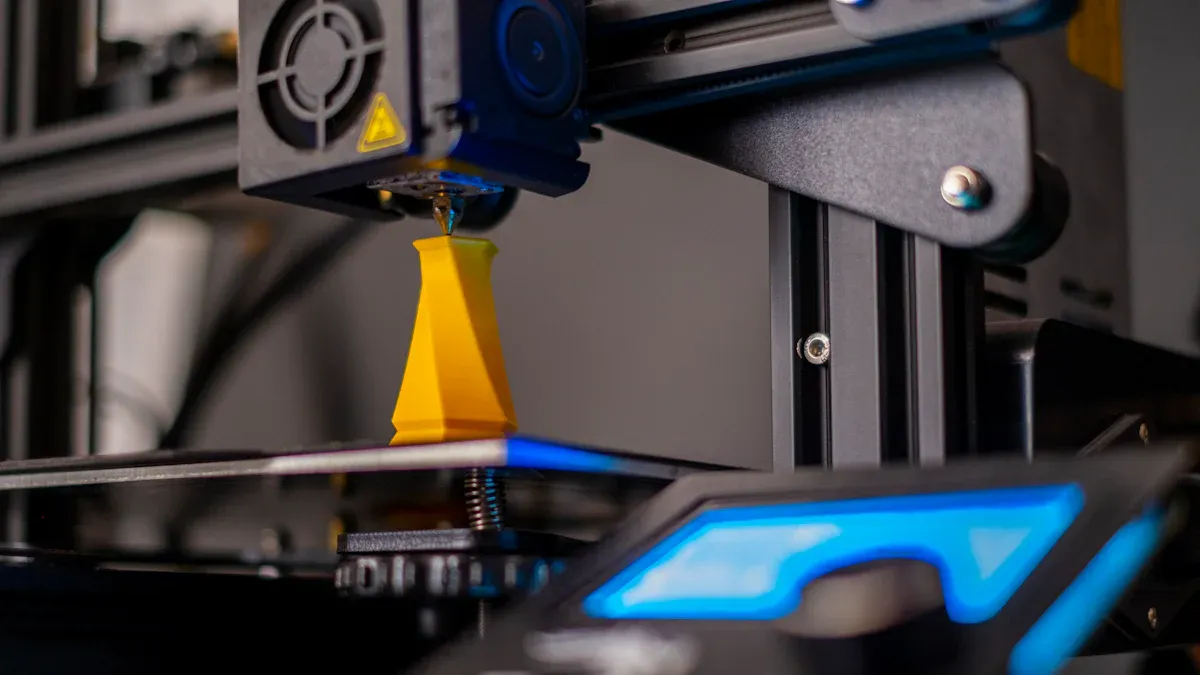
PETG is a good choice if you are new to 3D printing. It is easy to use and does not need high heat. PETG does not warp as much as ABS. It sticks well to the print bed. You do not need a closed printer for PETG. Parts made with PETG are strong and can bend without breaking.
But PETG has some problems. You might see thin strings or hairs between parts. This happens because PETG can ooze more than other filaments. Sometimes, blobs or extra material build up near the nozzle. This is common on the first layer. If the nozzle is too close to the bed, PETG can pile up and drag. You can fix these problems by slowing down the first layer and changing the nozzle height. PETG does not show tiny details as well as PLA or ABS. Small letters or sharp corners may look soft.
Common PETG print problems are:
- Strings and oozing between parts
- Blobs and buildup on the first layer
- Hard to get perfect settings for clean prints
Tip: Slow down your first layer and check your nozzle height for better PETG prints.
ABS Printability
ABS is a popular filament for strong and heat-safe parts. But it is harder for beginners to use. You need higher heat to print ABS. ABS can warp if the room is cold or windy. Many people use a heated bed and a cover to keep the heat even.
Here are some common ABS print problems and how to fix them:
|
Issue |
Cause |
Fixes |
|---|---|---|
|
Warping |
Cools too fast or uneven heat |
Use a heated bed and cover, make the bed hotter, add a brim or raft |
|
Layer Splitting |
Layers do not stick from heat loss |
Make the nozzle hotter, turn down the fan, print in a warm space |
|
Poor Bed Adhesion |
Bed is too cool or dirty |
Clean the plate, use ABS glue or a glue stick, change first layer height |
|
Strong Odor or Fumes |
ABS lets out smells when printing |
Open a window, use a filter, do not print in small rooms |
ABS can make sharp and strong parts. But you need to watch out for smells and warping. If you are new to 3D printing, PETG is easier to use. If you want to use ABS, make sure you have good airflow and a heated bed.
Strength & Durability
PETG Strength
When you want a tough 3d printing material, PETG stands out for its strength and flexibility. You can use PETG filament for parts that need to bend without breaking. If you drop a PETG print, it usually snaps under heavy load, but it resists cracking from everyday bumps. Take a look at these numbers:
|
Property |
Value |
|---|---|
|
Tensile Strength |
|
|
Impact Strength |
52.7 ± 2.4 kJ/m² |
You get strong layer adhesion with PETG, which means your prints stick together well. If you print with too much cooling, the layers might not bond as tightly, so keep your settings balanced. Some brands, like Dasfilament, offer even better strength and consistent results, especially at higher speeds. Sunlu PETG gives you good performance for less money. Not all PETG brands are equal, so check reviews before you buy.
- PETG filament is great for outdoor parts, tool handles, and containers that need to flex.
- You can use PETG for garden tools or clear covers because it resists water and UV light.
- PETG usually fails by snapping, while other materials like polycarbonate bend more before breaking.
Tip: If you need a part that bends and lasts, PETG is a smart choice.
ABS Strength
ABS filament is known for its toughness and heat resistance. You can use ABS for parts that need to handle stress and high temperatures. Here’s a quick look at the numbers:
|
Property |
Value (MPa) |
|---|---|
|
Tensile Strength σts |
25 - 50 |
ABS has a Charpy impact strength of 12.6 ± 1.1 kJ/m², which is much higher than PLA. You get prints that absorb impact and bend a little before breaking. ABS is less brittle than PLA and keeps its shape when things get hot. You can use ABS for car parts, machine prototypes, or cases that need to stay strong.
- ABS filament is stronger and more durable than PLA.
- It handles heat better, so you can use it for outdoor or mechanical parts.
- ABS can bend before breaking, giving you slight flexibility.
If you want a 3d printing material for functional parts, ABS is a solid pick. You get strength, durability, and heat resistance in one package.
Note: ABS is best for parts that need to stay tough and handle heat, but it is not as flexible as PETG.
Heat & Chemical Resistance
Heat Resistance Comparison
When you choose a 3d printing material, you want to know how much heat your part can handle. Both petg and abs have different limits. If you plan to use your print in a hot place, this matters a lot. Here’s a quick look at the recommended maximum use temperatures:
|
Material |
Recommended maximum use temperature |
|---|---|
|
PETG |
<70°C |
|
ABS |
<90°C |
You can see that abs handles higher temperatures than petg. If you need a part for your car or something that sits near a heat source, abs is the better pick. Petg works well for most indoor uses, but it can start to soften if things get too hot. For outdoor projects in the sun, petg usually holds up unless the temperature gets extreme.
Tip: If your print will face heat above 70°C, go with abs. For most home or hobby projects, petg is strong enough.
Chemical Resistance
You might wonder how petg and abs react to chemicals. This is important if you plan to use your 3d print around cleaners, oils, or other substances. Here’s what you need to know:
- Petg gives you better chemical resistance than abs. You can use petg in places where it might touch alcohol or cleaning agents.
- Abs does not like acetone. Acetone can dissolve abs and ruin your print. Even strong cleaning agents can damage abs over time.
- Petg stands up to most chemicals you find at home. It does not break down as easily as abs.
- Abs resists oils, acids, and bases, but it is still sensitive to some solvents. If you need a part for a workshop or garage, check what chemicals it might touch.
If you want a filament that can handle tough environments, petg is a safe bet. Abs works for many uses, but you need to watch out for certain chemicals.
Note: Always check what your print will touch before you pick a material. This helps your 3d project last longer.
Surface Finish & Post-Processing
Print Quality
When you look at the print quality of PETG and ABS, you notice some big differences. PETG usually gives you a smoother and more polished surface finish than ABS. If you want a glossy or transparent look, PETG stands out. You can use PETG for jewelry, miniatures, or any project where you want a shiny, clear appearance. ABS does not offer transparency, but you get a wide range of colors. You can paint ABS easily, so it works well for models that need different shades.
Here’s what you can expect from each 3d printing material:
- PETG filament creates glossy, smooth prints. You see fewer layer lines, but sanding does not always remove them because PETG resists abrasion.
- ABS filament prints show more visible layer lines. You can smooth ABS with acetone vapor, which gives you a shiny finish and hides lines.
- PETG’s glossy finish looks great, but it limits your ability to paint or polish. Paint does not stick well to PETG, so you need special primers.
- ABS lets you paint and polish your prints. You can use acetone vapor to make ABS shiny and strong.
If you want a print that looks polished right off the bed, PETG is a good choice. If you plan to paint or smooth your print, ABS gives you more options.
Post-Processing Steps
You can improve the quality of your prints with post-processing. Both PETG and ABS need different steps to get the best results.
- Sanding works for both PETG and ABS. Start with coarse sandpaper and move to finer grits. PETG is more resistant to abrasion, so sanding takes longer. ABS sands faster and easier.
- Painting your prints needs surface cleaning. PETG does not hold paint well, so you must use compatible paints and primers. ABS accepts paint after sanding or priming.
- Vapor smoothing is a special step for ABS. You use acetone vapor to melt the surface and create a glossy finish. PETG does not respond to acetone, so you use sanding or a heat gun instead.
- Gluing PETG works with cyanoacrylate or epoxy. ABS can be glued with solvent-based adhesives.
Tip: If you want a shiny, painted model, ABS is easier to work with. For clear, glossy prints, PETG is the best filament.
You can choose the right post-processing steps based on your project and the quality you want. Try different methods to see what works best for your 3d prints.
Cost & Availability
ABS Cost
When you look for a 3d printing material, price matters. ABS is one of the most affordable options for 3d printing. You can find abs filament almost everywhere, both online and in local stores. Most brands sell abs in 1kg spools, and the price usually sits between $15 and $30 per kilogram. Sometimes, you can find deals or bulk packs that make abs even cheaper.
ABS gives you good value if you want to print strong parts without spending a lot. Many schools and makerspaces use abs because it is easy to buy and fits most budgets. You might notice that abs costs more than PLA, but it is still less expensive than some specialty filaments. If you want to print large models or need a lot of material, abs helps you save money.
Tip: If you want to experiment or print many prototypes, abs is a smart choice for your wallet.
PETG Cost
PETG is a little more expensive than abs, but you get extra benefits. PETG filament prices can change depending on the brand and where you shop. In 2024, you can find petg for as low as $4.72 per kilogram if you buy wholesale. Most popular brands sell petg between $9 and $9.50 per kilogram. Some high-quality options cost up to $8.40 per kilogram. Here’s a quick look at petg prices from different suppliers:
|
Supplier |
Price Range (USD) |
|---|---|
|
Creality Hyper PETG Filament 1.75mm |
$9.0 - $9.5 |
|
Alibaba (Wholesale) |
$4.72 - $4.78 |
|
Numakers Best Quality 1 kg |
$5.4 - $8.4 |
|
Alibaba (1kg PETG Filament) |
$6.5 - $7.2 |
PETG is easy to find in most online stores and many local shops. You might pay a little more for petg, but you get better durability and weather resistance. If you want a filament that lasts outdoors or needs to handle water, petg is worth the extra cost.
Here’s a quick comparison to help you decide:
|
Filament Type |
Ease of Use |
Print Quality |
Durability |
Price |
|---|---|---|---|---|
|
PETG |
Moderate |
Moderately High |
Moderately High |
More expensive than ABS |
|
ABS |
Moderate |
High |
Moderate |
More expensive than PLA |
You can see that both abs and petg are easy to buy and use. PETG costs a bit more, but you get extra features. ABS is cheaper and great for everyday printing. PETG is the best filament for 3d printing if you need strength and weather resistance.
Note: Always check prices and reviews before you buy any material. Prices can change, and quality matters for your 3d projects.
Environmental Impact
Recyclability
If you care about the environment, you should know how easy it is to recycle your 3D printing material. PETG and ABS can both be recycled, but they are not the same. PETG gets recycled more often than ABS. Many recycling centers take PETG because it is used for food packaging and other things. You can even buy PETG filament that is made from recycled plastic. This helps you make better choices for the planet.
- PETG is easier to recycle at most local centers.
- You can use recycled PETG for your next project.
- ABS is not recycled as much and often goes to landfills.
A study shows that recycling is the most important thing for the environment with both materials. So, you should always try to recycle your prints if you can. Using recycled PETG is a good way to help the earth.
Safety & Ventilation
You need to stay safe when you use any 3D printing material. Both PETG and ABS make fumes when you print with them. These fumes can be bad for your health if you do not have good airflow.
Fumes from 3D printing can hurt your health, so you need good ventilation and safety steps when using ABS and PETG. ABS makes more dangerous fumes called VOCs and styrene, which can bother your eyes and nose or cause other problems. You should use a printer with a filter or open a window to let the air out. PETG makes fewer bad fumes, but you still need to keep the air moving to stay safe.
ABS gives off more harmful fumes than PETG. Always print ABS in a room with fresh air. Open a window or use a printer with a filter. PETG is safer, but you still need to keep the air moving. Never print in a small, closed room. Your health is more important than any print.
If you want to be safer, PETG is a better choice for home use. Always check your space before you start printing. A little care can keep you healthy.
Best Use Cases
Picking between PETG and ABS can seem hard. But you can choose the right one if you think about your project. Let’s look at when each one is a good idea, with easy examples and tips.
When to Choose PETG
Do you want a 3d printing material that is strong and flexible? PETG is a great choice for most people. It is good for beginners and works well outside. PETG is popular in the PETG vs ABS debate because it is strong, resists weather, and is easy to use.
Here are some times when PETG is best:
- Outdoor Projects: PETG does better in sun and rain than ABS. If you make garden tools or planters, PETG will last longer outside. Tests show PETG does not crack or fade fast in sunlight.
- Aquatic and Humid Environments: PETG is safe for fish tanks and things that go in water. You can print caves for shrimp or plant holders that do not break in wet places.
- Functional Everyday Items: Need a phone holder or wall hook? PETG is strong and bends without snapping. It is also good for replacement parts and clips.
- Flexible and Impact-Resistant Parts: PETG is good for drone parts, gears, and things that need to bend a little. If you want something that can take a hit, use PETG.
- Beginner-Friendly Printing: If you are new to 3d printing, PETG is easier than ABS. It warps less and sticks to the bed better.
- Food-Safe and Non-Toxic Uses: PETG is food-safe, so you can print kitchen tools or containers.
Here is a table to show where PETG works well:
|
Use Case |
Why PETG Works Well |
|---|---|
|
Outdoor planters & connectors |
UV/weather resistance, long-lasting |
|
Aquatic decorations & shelters |
Safe for water, durable underwater |
|
Utility hooks & wall mounts |
Strong, less brittle than PLA |
|
Tablet & phone holders |
Sturdy for daily use |
|
Replacement brackets & clips |
Flexible, won’t snap easily |
|
Drone/RC car parts |
Impact-resistant, handles vibration |
|
Gears & mechanisms |
Good for medium-load, flexible enough to prevent breakage |
|
Terrarium features |
Resists humidity, great for plant holders |
When to Choose ABS
ABS is a classic pick for strong and heat-safe prints. In the PETG vs ABS comparison, ABS is best when you need parts that can handle heat or stress. Many companies use ABS because it is tough and lasts a long time.
Pick ABS when you need:
- Automotive and Aerospace Parts: ABS is used in car dashboards and bumpers. It is also used for airplane parts that need to last.
- Consumer Electronics and Appliances: Many device cases and appliance parts use ABS because it is strong and heat-safe.
- Robotics and Prototyping: If you build robots or test designs, ABS is good for making working models. It is strong and lasts for years inside.
- Toys, Models, and Cosplay: ABS is popular for toys and costumes. It is easy to paint and finish, so your prints look nice.
- Custom Tools and Jigs: In workshops, ABS is good for custom tools and jigs. It handles stress and does not wear out fast.
- Sporting Equipment: ABS works for sports gear that needs to be tough.
Here are some common ABS projects:
- Car parts like dashboards and bumpers
- Airplane parts
- Electronic device cases
- Appliance parts
- Robotics and working models
- Toys and detailed models
- Custom tools and jigs
- Sports gear
- Cosplay suits and decorations
- Musical instruments
ABS is a good pick if you need:
- High heat resistance (up to 90°C)
- Strong, stiff parts that do not bend
- Smooth finishes with special steps like acetone vapor
- Prints that last a long time inside
Note: ABS can be hard for beginners because it warps and makes fumes. Make sure you have good airflow and a heated bed before you print with ABS.
PETG vs ABS: Quick Decision Guide
Still not sure which one to use? Here is an easy checklist:
Pick PETG if you want:
- Outdoor strength
- Water or humidity resistance
- Flexible, tough parts
- Easy printing for beginners
- Food-safe prints
Pick ABS if you need:
- High heat resistance
- Strong, stiff, and pro-looking parts
- Detailed toys or models
- Working models for robots or cars
- Easy painting and finishing
PETG vs ABS is not about which one is “better” for everyone. It is about what works best for your project. Think about where your print will go, how much stress it will get, and how much time you want to spend setting up your printer. With this guide, you can pick the right filament for your next 3d project.
Now you know how PETG and ABS are different. PETG is easy to print and sticks together well. It also does not break easily if dropped. ABS is better for things that get hot and need a smooth finish. If you want to make something for outside or that needs to bend, pick PETG. ABS is good for strong parts that must handle heat. Choose the filament that fits your project best. If you want more info, read guides about PETG, ABS safety, and what each is used for.
|
ABS |
PETG |
|
|---|---|---|
|
Mechanical Properties |
Good for hot places |
Sticks together well and resists hits |
|
Ease of Printing |
Needs a hot chamber and bed |
Easier to print and does not warp |
|
Applications |
Great for painting and gluing |
Good for chemicals and outdoor things |
|
Suitability |
Best for hot parts |
Best for clear prints and flexible use |
- Find tips to fix PETG printing problems.
- See how both compare for safety, price, and recycling.
FAQ
What makes petg easier to print than abs?
You can print petg without a heated chamber. It sticks well to the bed and warps less. You do not need special ventilation. Abs needs high heat and can warp if the room is cool.
Can I use petg or abs for outdoor projects?
Petg works well outside. It resists sunlight and rain. You can use it for garden tools or signs. Abs does not handle UV light as well. It can crack or fade if you leave it in the sun.
Is petg food-safe compared to abs?
You can use petg for kitchen tools and containers. It is food-safe and non-toxic. Abs is not food-safe. You should not use abs for anything that touches food or drinks.
Which filament is better for strong parts?
Abs gives you strong, stiff parts that handle heat. You can use it for car parts or electronics. Petg is flexible and tough. It bends without breaking. You can use petg for clips or brackets.
Do petg and abs release fumes when printing?
Both filaments release fumes. Petg makes fewer harmful fumes. You can print it in most rooms. Abs releases strong smells and VOCs. You need good airflow or a filter when printing abs.