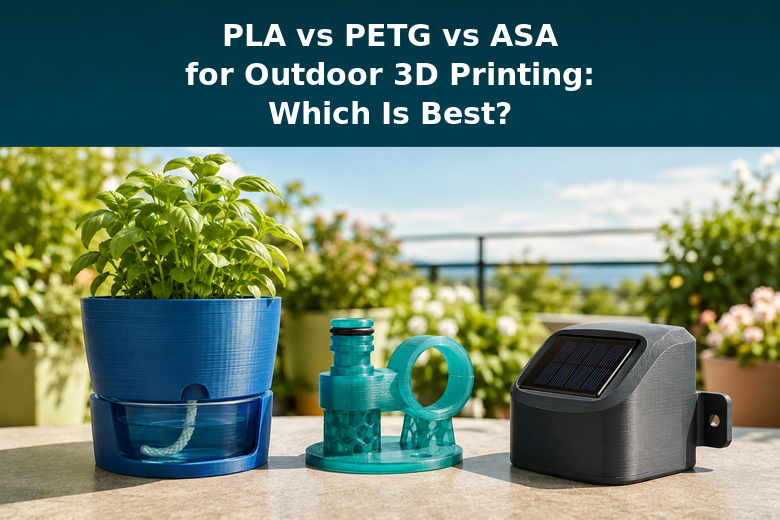
Quick answer (beginner-friendly): Choose PLA for shaded, decorative, or temporary outdoor prints. Choose PETG for most functional outdoor parts where moisture resistance and printability matter. Choose ASA for long-term direct sun and heat exposure—if your printer setup can control warping and you can ventilate properly.
Key Takeaways: PLA can work for shaded or temporary outdoor parts, PETG is a practical choice for many functional prints, and ASA is typically the better pick for long-term sun and heat exposure—if your setup can handle the tougher print requirements.
Quick comparison table (outdoor-focused)
|
Criteria |
PLA |
PETG |
ASA |
|---|---|---|---|
|
Heat resistance (real-world sun) |
More likely to soften in warm conditions, especially in dark colors or thin sections |
Generally more tolerant than PLA in warm outdoor conditions |
Often chosen when parts need the best chance against heat exposure outdoors |
|
UV resistance |
Often the weakest of the three for long-term direct sun |
Commonly described as “moderate”; can age in sun over time |
Commonly considered the most UV-stable choice for outdoor prints |
|
Strength & toughness |
Stiff and dimensionally crisp, but can be more brittle depending on part geometry |
Good balance of toughness and flexibility for functional parts |
Tough and weather-oriented; often picked for long-term outdoor durability |
|
Ease of printing |
Easiest; low warp risk |
Moderate; watch stringing and bed adhesion/release |
Hardest; warping control matters most |
|
Moisture sensitivity (printing & storage) |
Benefits from dry storage; can degrade over time if poorly stored |
Also benefits from drying; humidity can show up as stringing/surface issues |
Benefits from dry storage; print environment matters a lot |
|
Surface quality |
Often the cleanest detail and sharp edges |
Smooth/glossy is common; can show strings/ooze if untuned |
Can look great, but drafts/cooling/warp control strongly affect finish |
|
Typical “best use” outdoors |
Decorative, shaded, or short-term |
Many functional parts (especially where moisture is a factor) |
Long-term sun + heat exposure functional parts |
Note: “Heat resistance” numbers vary by how they’re measured (glass transition temperature vs heat deflection temperature), the filament formulation, and part design. For any critical part, check the manufacturer’s datasheet and run a small outdoor test print.
|
Material |
Typical heat-deflection range* |
|---|---|
|
PLA |
About 50–60°C |
|
PETG |
About 70–90°C |
|
ASA |
About 90–110°C |
*These are approximate ranges (not guaranteed service temperatures). Actual performance depends on the filament formulation, print settings, part geometry, color, and load. Ranges adapted from Prusa Research’s Filament Material Guide.
PLA vs PETG vs ASA: the criteria that actually matter outdoors
If you arrived here searching for PLA vs PETG vs ASA for outdoor 3D printing, you’ll get the most useful answer by matching the filament to your exposure conditions (direct sun vs shade, constant load vs cosmetic) rather than trying to crown one “best” material for every scenario.
1) Heat resistance: softening, creep, and why your part bends in the sun
If your search is really about a heat resistant filament for outdoor parts, focus on the combination of (1) the filament’s thermal behavior, (2) the part’s geometry, and (3) whether the part is under constant load in the sun. Those three together predict droop and deformation better than a single headline temperature number.

For outdoor parts, “heat resistance” usually shows up as softening and creep—a bracket that slowly droops under load, an organizer that starts to sag, or snap-fits that lose tension.
- PLA is often fine until it isn’t. In direct sun (especially on dark surfaces), it can soften sooner than people expect. That doesn’t mean PLA is “never outdoor-safe”—it means you should treat PLA as riskier under heat + load.
- PETG is widely used as a practical step up for warm conditions. Many makers choose it when they want more margin than PLA without moving to higher-warp materials.
- ASA is commonly chosen when heat exposure is a primary risk (sun-facing parts, near hot equipment, car-adjacent accessories). In general, ASA tends to offer more temperature margin than PLA and PETG—but results still vary by brand and formulation. For a quick reference point, Prusa’s Filament Material Guide lists higher typical heat-deflection ranges for ASA than PLA and PETG.
Practical rule: If the part is under constant load and sees sun, design for heat first: thicker walls, more ribs, and less “long skinny cantilever.” Material choice helps, but geometry often decides the outcome.
2) UV resistance: the slow damage you don’t notice until it snaps
If you specifically need a UV resistant 3D printing filament, ASA is often the first material people reach for in FDM because it’s designed with outdoor weathering in mind. PETG can still work outdoors, but many makers treat it as “good, not forever” in direct sun.

UV damage is rarely dramatic on day one. It’s more like: fading, chalky surface, and eventually brittle failure.
- PLA is commonly considered the least UV-stable of the three over long exposure.
- PETG is often described as better than PLA but still not truly “weatherproof forever.” Depending on the brand and pigment, it may discolor or become more brittle over time.
- ASA is widely used specifically because it’s designed for outdoor weathering compared to ABS-like materials. Sovol’s own overview of outdoor filaments frames ASA as the stronger UV-oriented option versus PETG for outdoor parts (with print-condition caveats).
If you only remember one thing: UV exposure is why “it printed great” doesn’t guarantee “it survives a season outside.”
3) Strength and toughness: don’t mix up stiff with durable
Outdoor parts often fail by impact (knocks, drops, wind vibration) or by fatigue (small repeated loads).
- PLA can be very stiff and can hold shape well in mild conditions, but stiffness doesn’t automatically mean durability outdoors—especially if heat and UV are in play.
- PETG is popular for functional parts because it tends to balance stiffness with toughness (it can flex instead of snapping in some geometries).
- ASA is often chosen when you want a tougher, more weather-focused plastic for outdoor service.
If you’re printing brackets, organizers, or clips, don’t only ask “which is strongest?” Ask “what kind of failure is acceptable?” A slightly more flexible part that doesn’t crack can be the better outcome.
4) Ease of printing: warping is the real tax of outdoor-grade materials
This is where the decision usually gets made.
- PLA is forgiving: low warping tendency, broad settings window, and generally doesn’t require an enclosure.
- PETG is approachable, but tuning matters more. It’s notorious for stringing/oozing and can have strong bed adhesion (sometimes too strong on smooth surfaces). If you’re dialing it in, Sovol’s guides on essential PETG print settings and troubleshooting PETG adhesion and stringing are useful starting points.
- ASA is the most demanding of the three for many hobby setups because it’s more sensitive to drafts and uneven cooling, which can cause warping and corner lift.
⚠️ Warning: ASA printing can produce noticeable fumes/odor. Use good ventilation, and consider an enclosure with controlled airflow. Always follow your filament manufacturer’s safety guidance.
5) Moisture sensitivity: it’s not just nylon that needs drying
PLA, PETG, and ASA all benefit from sealed storage with desiccant. Moisture may cause popping, stringing, rough surfaces, and inconsistent extrusion during printing. PETG often shows moisture-related defects more visibly, but the actual effect depends on the filament formulation and storage conditions.
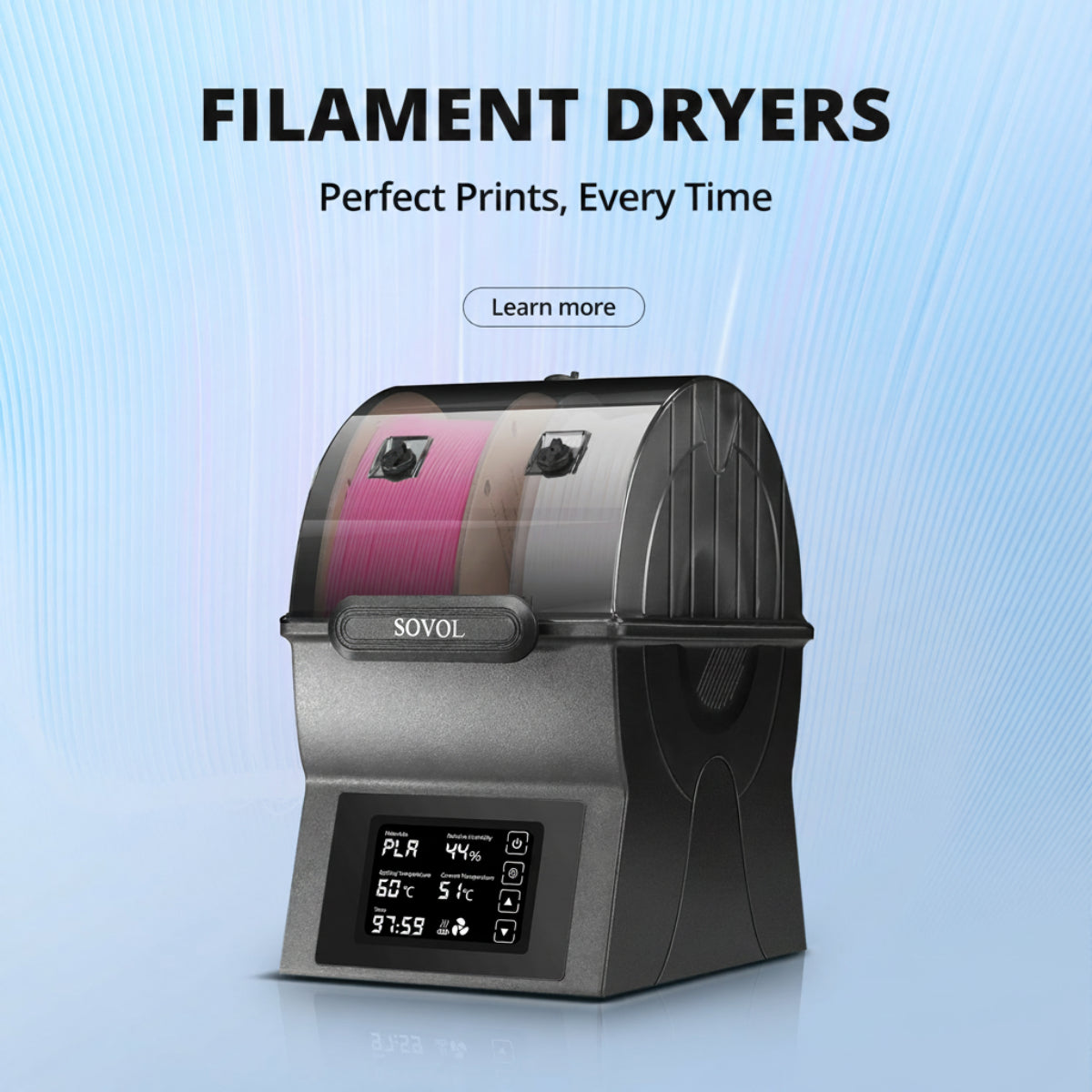
A simple workflow: store spools sealed with desiccant, and dry the spool if you notice surface defects or inconsistent extrusion. Prusa’s Drying filament guide is a useful reference for typical drying temperatures and times. If you’re shopping for drying gear, see Sovol’s filament dryer options.
6) Surface quality: pick your battles
If surface finish is the priority (decorative parts, crisp text, clean corners):
- PLA tends to win on ease and aesthetics.
- PETG can look very smooth, but untuned PETG can leave fine strings and “zits.”
- ASA can look great too, but it punishes poor thermal control; a drafty room can show up as both warping and inconsistent surface.
Recommendations by real outdoor use case
Below are practical, conservative recommendations. Treat them as starting points—your geometry, wall thickness, infill, color, and exposure conditions matter.
Safety note: Do not use 3D-printed parts for fall protection, overhead loads, electrical safety, or any application where failure could cause injury or property damage. Always test prototypes with a safety margin and inspect outdoor parts regularly.
Balcony accessories (clips, hooks, plant ties, shade-side mounts)
- Good default: PETG, especially if the part sees occasional water and needs a bit of toughness.
- PLA can work when: the part is shaded most of the day, not load-bearing, and you’re okay with it being a “seasonal” print.
- Choose ASA when: the part is sun-facing and subject to a non-safety-critical load, provided that you can test it under the expected outdoor conditions.
Garden parts (hose guides, sprinkler brackets, drip-line clips)
- Good default: PETG for moisture-heavy environments.
- Choose ASA when: parts live in direct sun for long periods or need extra margin against heat.
- PLA use case: short-term prototypes or low-stress pieces you can easily reprint.
Brackets (camera mounts, sensor housings, corner brackets)
- PETG for many functional brackets: good balance of durability and printability.
- ASA for long-term installations: especially if the bracket is sun-facing or holding a constant load.
- PLA only if: the bracket is indoors-facing, shaded, or purely a fit-check prototype.
Outdoor organizers (tool holders, wall-mounted bins, cable guides)
- PETG: a strong first choice for organizers exposed to humidity or splashes.
- ASA: better when organizers are in direct sun or near heat.
- PLA: decorative/low-load organizers in covered areas (porch, shaded balcony).
Prototypes (fit checks, airflow tests, quick iterations)
- PLA: fastest path to iterate. For outdoor prototypes, you can still learn a lot about fit and assembly.
- PETG: use when the prototype needs to survive handling, screws, and repeated assembly.
- ASA: reserve for late-stage prototypes when outdoor exposure is part of the test.
Decorative models (planters, signs, garden decor)

- PLA: great for detail and color—best when kept shaded or treated as seasonal decor.
- PETG: useful if you want more toughness and moisture tolerance.
- ASA: best bet of these three for decor that sits in direct sun long-term.
Pro Tip: If you’re unsure, print a small “outdoor coupon” (a simple strip with a hole and a snap feature) in your candidate material. Put it outside for a couple weeks and test it: bend it, snap it, and check whether it softened or got brittle. A few weeks of outdoor testing can reveal short-term heat and mechanical issues, but it cannot fully represent long-term UV aging.
Printing notes that prevent most outdoor failures
- Read the spool label and datasheet first. Filament formulations vary. Use manufacturer temperature and fan ranges as your starting point, then tune.
- Design for outdoors, not just the material. Add ribs, avoid long thin arms, and use generous fillets to reduce stress concentration.
- Control warping at the source. ASA especially benefits from a stable print environment (often an enclosure) and careful cooling.
- Plan for fasteners and UV. Metal hardware can concentrate stress; consider washers and thicker bosses. For long-term outdoor parts, coatings/paint can help—but test on your filament first.
FAQ: PLA vs PETG vs ASA for outdoor 3D printing
Is PLA OK outdoors at all?
Yes—sometimes. PLA can be reasonable for shaded, low-stress, or temporary outdoor applications where heat build-up is limited and you’re comfortable reprinting if it ages faster than expected.
Is PETG UV resistant enough for outdoor use?
PETG is often described as having moderate UV performance and works well for many outdoor functional parts, especially in wet environments. For long-term, direct sun exposure, many makers still move to ASA for extra UV margin.
Is ASA better than PETG for outdoor prints?
For many “direct sun + summer heat” scenarios, ASA is often chosen over PETG because it’s designed to handle outdoor weathering better. That said, PETG vs ASA for outdoor use isn’t a blanket verdict: PETG can be the better choice when you need easier printing, good moisture tolerance, and your part isn’t baking in direct sun all day.
Do I need an enclosure to print ASA?
Many users find an enclosure helps significantly with ASA by stabilizing temperature and reducing warping. Whether it’s strictly required depends on your printer, room conditions, part size, and the specific filament.
Which filament is best for outdoor brackets?
If the bracket is shaded and lightly loaded, PETG is often a practical default. If it’s sun-facing, heat-exposed, or load-bearing long-term, ASA is usually the safer direction—assuming you can print it reliably.
What matters more: material choice or design?
Both matter, but design is often the first lever. A well-designed PETG bracket (thick enough, ribbed, no sharp corners) can outlast a poorly designed ASA bracket.
Next steps
If you want a simple, practical baseline for functional outdoor prints, many makers start with PETG and graduate to ASA when direct sun + heat exposure becomes the limiting factor.
To browse options and compare colors, you can explore Sovol PLA and PETG filaments and match the spool’s recommended settings in your slicer.
Related reading
For a deeper comparison that includes ABS, see our ASA vs PETG vs ABS for Outdoor 3D Printing.